Never Stop Pre at Pre’s Rock
My new book about the Oregon distance legend Steve Prefontaine has finally come to rest at Pre’s Rock. A friend placed several copies there and I hope visitors to this unique shrine have already taken them.

My new book about the Oregon distance legend Steve Prefontaine has finally come to rest at Pre’s Rock. A friend placed several copies there and I hope visitors to this unique shrine have already taken them.
Never Stop Pre: The Enduring Inspiration of America’s Greatest Sports Legend
By Matt Love
“Pre was more than a name—it was a condition.” Ken Kesey
On May 31, 1975, Coos Bay, Oregon native Steve Prefontaine died in an automobile accident. At the time of his death, he held 14 American records in distance running.
Pre was 24 years old and already a legend in Oregon and the world of track of field.
A half century after his tragic end, his remarkable story continues to inspire others on a near mythological level to compete in a multitude of ways, from Phil Knight to a country singer to an Iraqi War vet to an impoverished high school runner to a man battling addictions to an obsessed sculptor to a writer and teacher on the brink of suicide and so many more.
In Never Stop Pre: The Enduring Inspiration of America’s Greatest Sports Legend, Matt Love, prolific an award winning chronicler of modern Oregon history, races the reader through a decathlon of literary genres to investigate the ongoing phenomenon and spectacular influence of Steve Prefontaine.
“There has never been a cultural sensation quite like Steve Prefontaine, said Love. “Over the course of many decades, I kept running into people who were inspired by Pre to change their lives for the better. Pre has a way of doing that like no American athlete before or since. Never stop Pre. When he’s no longer relevant in Oregon, Oregon is dead.”
Never Stop Pre is a lively 125-page book that breaks new documentary ground on Pre’s remarkable story and introduces the reader to more than a dozen fascinating personal narratives that recount Pre’s magic upon people’s lives. It’s a book about a unique sports legend whose short, meteoric life transcended awesome sporting accomplishments.
Available as a print or e-book on Amazon or Nestuccaspitpress.com and sold in select retail outlets around the Pacific Northwest.
Not too long ago, I sat at the bar at my local watering hole, finishing my Oregon IPA. It was a pretty much dead Friday afternoon and some vintage soul drifted through the speakers while Fargo played silently on television.
To my right three stools away, a vaguely 40ish woman with arms covered in tattoos drank a cocktail and fiddled on her phone.
I was about ready to depart when the bartender asked me if I had summer travel plans. I said I might visit the Coos Bay area. I liked it a lot better than the suburban amusement parks of Cannon Beach or Manzanita. I liked the grittiness of the place and there with still functioning Oregon Tavern Age joints where customers still told stories about drinkin, tokin, fightin, loggin, muddin, fishin, home improvement, and how occasionally an osprey accidentally dropped an eel or salmon on their property and they would promptly fry it up for supper.
A few seconds after I ended my praise of Coos Bay, the woman down the bar turned to me and said, “I’m from Coos Bay!” and said it with gusto and pride.
She got up and sat a few stools closer to me. Another drink materialized in front of her and she guzzled it. I got the distinct impression she wanted to talk about Coos Bay and I love talking about Coos Bay, especially to a refugee from the place, so let’s talk!
In short order, I learned she’d grown up there and dropped out of high school in the 90s at the age of 13. She partied hard in the dunes and clearcuts. She escaped to the Willamette Valley and eventually landed in Portland, but had recently entertained the idea of returning to her hometown and starting over; she was through with Portland. Her life was going nowhere and she was on her third cocktail in the early afternoon.
I said I wanted to relocate to somewhere to that area when my Portland days conclude, whenever that might be.
Yes, when will that be?
I then asked if she was familiar with Steve Prefontaine, the legendary Oregon distance runner who grew in Coos Bay and attended Marshfield High School and later the University of Oregon and shattered every long distance record at both levels.
She look at me as if I just proven the existence of Santa Claus. Her face erupted in smile. She finished her drink. Why not another one?
Hell yes, she knew about Steven Prefontaine! She’d competed in the Steve Prefontaine Memorial Run several times in her youth! It was a 10k event held in September with also a 2k fun run but she always took on the longer mileage.
I tried imagining her as a kid poised to take off at the crack of the gun and follow Pre’s indomitable legacy and I wasn’t imagining it too well with her hitting the sauce hard and generally seeming displaced and disjointed in her world.
I asked her if she’d ever visited the Prefontaine Memorial Gallery in the Coos Art Museum. It’s a one-room shrine to the greatest athlete in Oregon history and the most hallowed and inspiring American place I’ve ever visited and that includes the Pennsylvania State House where the slaveholders signed the Declaration of Independence and the Lincoln Memorial.
She said she’d never heard of it. What? I told her she had to go, immediately! I said it can help get your life turned around in ways conventional, cornpone and expensive therapy can only dream about and I knew that from personal experience.
She was intrigued. I told her about the guest register that visitors to the gallery sign into and record their feelings about Pre. I’ve read through various volumes over the years and it’s easily the greatest spontaneous testament to an individual sporting life that exists in American history that I am aware of. I said she had to sign in and share her thoughts. The very act of writing it in longhand could very well spark a revolution in her troubled spirit, although I didn’t say “troubled” but she got the idea.
I do know when I start talking to someone about something uniquely Oregon, like Pre or Vortex I or Matt Kramer or Conde McCullough’s coastal bridges or the state’s socialist ocean beaches or driftwood forts, I tend to get that person very, very fired up. Shit, I fire myself up!
It was time to go. I told her to get her ass to Coos Bay and the gallery. She said she would. Then she went back to her phone and I could tell she was looking up the gallery.
In the past, some have called me Dr. Love and my prescription for a better life has always been the same: Oregon, Oregon, Oregon. And I take my medicine as often as I can. It once saved my life.
Scene 1
In 1975, the Oregon Legislature passed House Concurrent Resolution 11. It reads:
Whereas Steve Prefontaine died May 30, 1975; and
Whereas Steve Prefontaine was the nation’s most outstanding distance runner, holding American records at 3,000 meters, two miles, three miles, 5,000 meters, six miles and 10,000 meters; and
Whereas Steve Prefontaine came out of the Oregon coastal community of Coos Bay where he had been a national high school champion, went to the University of Oregon where he won the NCAA three-mile championship three times and the cross country title four straight years, and went to the 1972 Olympics in Munich where he placed fourth in the 5,000 meters; and
Whereas Steve Prefontaine drew admiration and respect as a sincere, outspoken and indefatigable advocate of a national program to enable amateur athletes to more effectively participate in international competition; and
Whereas Steve Prefontaine served as an inspiration for all those who wish to excel in life; now, therefore,
Be It Resolved by the Legislative Assembly of the State of Oregon:
That the Fifty-eighth Legislative Assembly mourns the death of a truly dedicated runner who brought much to all who were privileged to know him, Steve Prefontaine…
Around the same time, a poet named Charles Ghigna published a poem titled “Prefontaine.” Since its publication the poem has been widely included in anthologies of sports poems from a long lost literary era when poets wrote poems about sports and athletes such as Muhammad Ali, Billie Jean King, Bill Russell and Gale Sayers and prestigious magazines and journals published them. Ghigna had competed against Prefontaine and lost, which made perfect sense because nobody writes a poem about someone you beat in athletic competition.
The poem reads:
Prefontaine
He wore old Oregon on his chest,
a new mustache on his 24-year-old lip
and a scowl on his brow
that could jump out of his mouth
quicker than that famous final kick.
We all agreed
he could run and run and run
after women and whiskey and ribbons,
a chip off the old lumberjack block.
We in the stands gave our clapped-red hands
to him and his victory laps.
We watched and prayed for his runty form
under suns, gym ceilings and television rooms.
He stood us wild after each mile
witnessing his sudden bursts of speed.
We curse a coffin car we never saw.
In 1995, a film documentary titled Fire on the Track: The Steve Prefontaine Story was released. It was narrated by Ken Kesey. In 1997, Hollywood released a biopic of Steve Prefontaine titled Pre. It starred Jared Leto. In 1998, Hollywood released another biopic of Steve Prefontaine, this one titled Without Limits. It starred Billy Crudup.
“A lot of people run to see who’s the fastest. I run to see who has the most guts.”
So said Oregonian Steve Prefontaine, who died in 1975 at the age of 24 when he crashed his sports car into a rock and prematurely ended a running career that saw him set 14 American records, including the high school two-mile mark (on a cinder track) that still stands. (Photograph of Pre here by Gerry Lewin.)
Pre hailed from Coos Bay, a gritty mill, fishing and port city on the remote South Oregon Coast. He was a logger’s son, too runty (or brooding) for football, so he took up running, trained relentlessly in the dunes, graduated from Marshfield High in 1969, and ran track for the University of Oregon where he turned running into a combination spectacle of performance art, animal instinct, existential abandon, rock and roll, Zen Buddhism and rebellion that nobody had ever seen before and would ever see again. Loggers and fishermen used to root for him to win. He got a whole state to take up running as exercise.
I’ve been thinking about Pre a lot these days—his reality, his metaphor, and the aforementioned quote. Do I have the guts to finish this race? It’s not about running the fastest. It’s not a race I can possibly win because it has no set distance or even a direction. It just keeps going and going, not around a track or along a cross-country course. It’s a race through the labyrinth of The Registry. I doubt Josef K would have finished or even broke a sweat.
“Guts.” Who uses that word in sports or life anymore? Let’s bring it back.
Pre would party all night and then wake up, win with a hangover and set an American record. He had hot groupies. He took off at the gun and ran competitors into the ground. People flocked to Hayward Field in Eugene to see him race and he made the city the track and field capital of the United States. He didn’t have a corporate sponsor. No one did then. It was the sham era of “amateurism” in world track and field (tennis too), and it amounted to one of the biggest cultural farces of the 20th century. He tended bar to make ends meet. He bucked hay.
I absolutely relish the idea of Pre serving dime drafts of Pacific Northwest lagers then brewed in the Pacific Northwest to Oregon Tavern Age men in Eugene. They probably hated his long hair but they had cheap beer in common and that soothed it out.
Pre won the 5000 meters at the 1972 Olympic Trials, went on to compete at the cursed Munich Games. As an eight-year old living in Oregon City in 1972, I was glued to a huge Zenith for the 5000-meter Olympic final. All of Oregon was. I will never forget watching that race, Pre running an uncharacteristic conservative race and getting nipped at the finish line for third place, losing out on the bronze medal. But we all knew he would back in ‘76, our Bicentennial year, to defeat the blood doping Finns and the chemically-enhanced East Germans.
I went out for track my seventh grade year in 1976 and ran distance. I wanted to be Pre. I had some success and even set a school record that spring for the 1320-yard race (three times around), a record that will never be broken because everything track and field in America changed over to the metric system a year or two later and they started running the 1500 meters. Thus, I live in sports immortality at Gardiner Junior High in Oregon City. I’ll gladly take it.
Really, though, I wasn’t Pre and couldn’t hack distance running. I quit that summer and took up tennis. I was never able to transfer his energy and spirit to the tennis court. I wish I had tried.
Pre is an American distance running legend and the toughest, most famous Oregon athlete of all time. It’s not a debate. They made a couple of movies about him, Billy Crudup and Jared Leto in the leads. They were mediocre and offered nothing in the way of mysticism about Pre. He was a mystic of movement and competition. His kind is impossible for a professional athlete today. Too much money at stake. Budweiser and a shoe company would own and geld him.
Several years ago, I found myself in Coos Bay with time to live. I suddenly remembered reading something about a Pre museum somewhere in the city. I found it by asking around town.
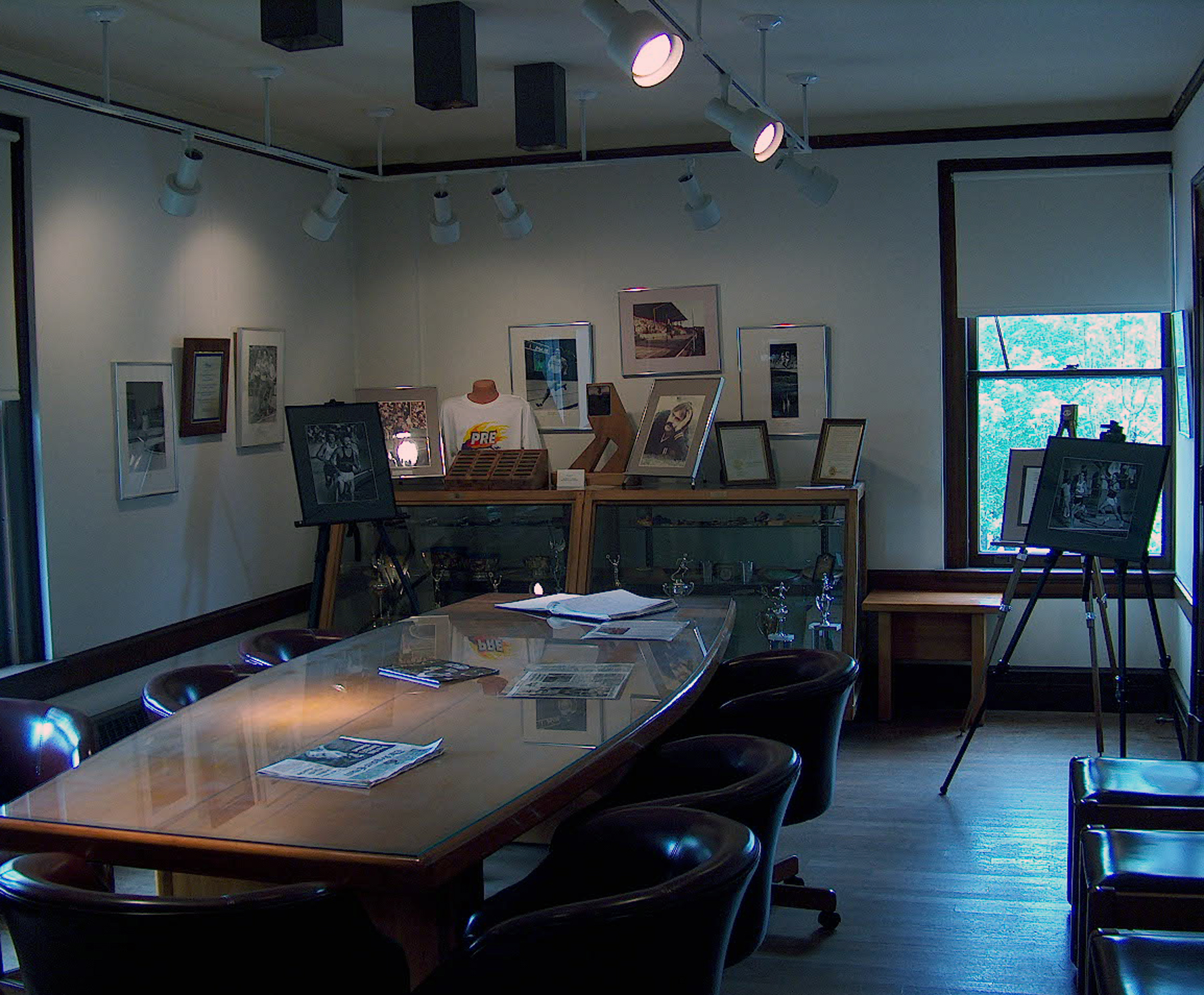 Located in a small room on the second floor of the Coos Art Museum, is the Prefontaine Memorial Gallery. I was alone during my visit. It didn’t cost a cent.
There are photographs, his medals, trophies and awards. There is a Joint Resolution by the Oregon Legislature passed after Pre’s death that reads:
Whereas Steve Prefontaine died May 30, 1975; and
Whereas Steve Prefontaine was the nation’s most outstanding distance runner, holding American records at 3,000 meters, two miles, three miles, 5,000 meters, six miles and 10,000 meters; and
Whereas Steve Prefontaine came out of the Oregon coastal community of Coos Bay where he had been a national high school champion, went to the University of Oregon where he won the NCAA three-mile championship three times and the cross country title four straight years, and went to the 1972 Olympics in Munich where he placed fourth in the 5,000 meters; and
Whereas Steve Prefontaine drew admiration and respect as a sincere, outspoken and indefatigable advocate of a national program to enable amateur athletes to more effectively participate in international competition; and
Whereas Steve Prefontaine served as an inspiration for all those who wish to excel in life; now, therefore,
Be It Resolved by the Legislative Assembly of the State of Oregon:
That the Fifty-eighth Legislative Assembly mourns the death of a truly dedicated runner who brought much to all who were privileged to know him, Steve Prefontaine…
The crown jewel of the museum, easily my favorite museum in the world, is a large, handsomely bound register where visitors can record in their own writing what Pre meant to them. It took me 30 minutes to read all the messages, dating back to the late 1980s.
I started crying when I read them. People poured it out. There is nothing like this in the annals of American sporting history. When I finished, I knew I had read one of the most unique and moving testaments to the spirit of an American life that exists in our culture. And it’s in Coos Bay, Oregon! In a handwritten ledger!
Who signed in? Entire high school cross-country teams on a pilgrimage. Those who raced against Pre—and lost. His hometown buddies. Former Oregon Ducks. Europeans. Fans. What did they write? How about lines like, “I find Steve’s pure focus replenishing…Pre, thanks for reminding me why sports matter…I liked watching you run…”
I too, left my message for Pre: “You were a Stone Oregon God!”
Oddly enough, in the museum, I found no framed copy of a poem about Pre by Charles Ghigna that has been widely included in anthologies of sports poems. I tracked down Ghigna and secured his permission to reprint the poem. So here it is, from a poet who competed against Pre and LOST. (Who writes a poem about someone you beat?)
Prefontaine
He wore old Oregon on his chest,
a new mustache on his 24-year-old lip
and a scowl on his brow
that could jump out of his mouth
quicker than that famous final kick.
We all agreed
he could run and run and run
after women and whiskey and ribbons,
a chip off the old lumberjack block.
We in the stands gave our clapped-red hands
to him and his victory laps.
We watched and prayed for his runty form
under suns, gym ceilings and television rooms.
He stood us wild after each mile
witnessing his sudden bursts of speed.
We curse a coffin car we never saw.
You can’t Stop Pre. That kick. The guts.
(If you found this post enjoyable, thought provoking or enlightening, please consider supporting a writer at work by making a financial contribution to this blog or by purchasing an NSP book.)