
Nestucca Spit Press Meditations Blog
A Blog by Matt Love
  • Home
  • About
  • NSP Categories
    • NSP Meditations
    • Lost and Found
    • Writing
    • Driftwood Forts
    • Oregon Beaches
    • Of Walking in Rain
    • Oregon Coast_History
    • NSP Correspondents
    • Oregon Tavern Age
    • Astoria
    • Fiction
    • Poetry
  • Back to NSP
  • Contact
RSS
August 1, 2017

Streams of Driftwood Fort Consciousness

Matt Love Driftwood Forts, NSP Meditations, Oregon Beaches beaches, driftwood forts, Elinor Wylie, gruel, matt love, Oliver Twist, Oregon Coast, stoic bird, tennis

Lines written from a driftlog after building a driftwood fort.

The French writer Stendahl had 171 pseudonyms! I need one. I never thought I would would have to disavow my last name to see my writing about Oregon published by some other media entity besides Nestucca Spit Press, but there seems to be no other way. I turned Love into Hate. Imagine that trick of life. Maybe I’ll hit rock bottom when I deny my own name and see a fake one in print. At long last, is that really the end of the deep fall, to the awful splat! of the concrete floor?

I wish knew how to sew. I have uses for the skill. I wish I knew how to caulk. I will soon have uses for the skill.

Someone constructed a cairn that reminded me of Stonehenge.

I found a love poem written with the ink of an octopus. The poet discovered a dead one washed ashore and salvaged the ink. Interesting things end up on Port Orford beaches, including human beings.

I met a man who lost everything in a divorce, spent six months in jail for violating a restraining order, and as is now living in a tiny fifth-wheel trailer. He told me he likes it. “Simple.” He also promised to show me how to fish for surf perch. Oh, the people you meet in the margins! I much prefer writing about them than myself, although I am certainly in the margins these days.

I reached out to a long lost friend. She was happy to hear from me.

An old friend reached out to me and gave me a gig that allows me to put my writing talents to good use for Oregon. I thanked my friend for giving me the opportunity. I need more of them.

I’ve let go of all notions of control. For me, it’s a novel way of living life.

Tennis, tennis, tennis. I want to renew my love affair with the game that used to be an important part of my life. I can hit off the backboards, but at some point I’ll want someone to play with. We don’t even have to keep score. Why bother?

My unique book distribution system continues to bear fruit, connecting me to a fascinating new readership.

My dad quoted an interesting stanza of poetry to me the other day, from Elinor Wylie’s, “The Eagle and the Mole.”

Avoid the reeking herd/ shun the polluted flock / live like the stoic bird

Live like the stoic bird. I like the sound of that for myself and a rock band name.

Stoic birds don’t loathe. They live forever.

I was reading Oliver Twist and something occurred to me: my previous friendships were as thin as a Dickens’ gruel. I made the gruel and served it. I tasted it, too, and my body thought it was nourishing.

My letter writer wrote me two letters worthy of literature. One of them was about rivers. I read it by the river.

I’m going gray. That’s not the only thing about me that’s changed. The interior ones are way more pronounced. The book is in those interior changes. If I can write it. Sometimes I think I should write a book about Bonnie and Clyde instead. Isn’t writing from joy a better place for me now, better than the precarious place I am in now?

(If you found this post enjoyable, thought provoking or enlightening, please consider supporting a writer at work by making a financial contribution to this blog or by purchasing an NSP book.)
July 31, 2017

Bonnie and Clyde Files 13

Matt Love Bonnie and Clyde Files, NSP Meditations, Poetry Bonnie and Clyde, dog sanctuary, dogs, Japanese poetry, old dogs, oregon, Oregon rivers, poetry, Rainier beer, tanka


After three tries with various agencies, the man was ready to give up on securing an official identity for himself. Officially, he didn’t exist in the Unites States of America and wouldn’t for the foreseeable future even though he’s lived in the country of his birth his entire life and was a real person, Caucasian, roughly 45 years old.

There I was, in the probation office meeting room, looking at a man in the system forever but entirely disappeared from the system.

Have you ever sat across from someone who doesn’t exist and looked into their face for clues to existence? I have. I will never forget that faceless face. It was wracked with resignation, indifference and invisibility—A Total Giving Up Everything and No One is Noticing. The verb wracked typically isn’t employed in connection to the action of a faceless face registering resignation, indifference and invisibility. It is verb of stress and torment that patterns the face and contorts the body. What I saw on display in that room was a whole new way of wracked as a verb. Frankly, it was one of the most dispiriting things I ever witnessed in my life and I witnessed it from five feet away.

I was thinking of the American man who didn’t exist as I pulled into the Sanctuary. Bonnie barked and Clyde damn near busted down the gate to the back yard to get to me. You never forget welcomes like that. People should emulate those kind of welcomes every once and a while. Lose the decorum and go wild!

River time! From the land of sky blue waters, Tom McCall, rain, clearcuts and fake hatchery fish. Time for ablution after the probation office. I dropped off more donated items for the Sanctuary rummage sale and then the crew and I made our way to the river. I was tossing treats into the air like confetti and the old bank robbers were gobbling them up in near delirium. I did a little kick-up-the-heels jig in the pasture and gave thanks to these two old dogs and how they invigorate me. Where would I be without them?

We reached the river. Water skippers and swallows dominated the scene. It was hot, as in cracking-cold-Rainier-time-by-the-river hot. There was no breeze, no shade. We were dying out there; 64 degrees on the Oregon Coast is practically unbearable. I found a branch, tossed it into the current, and watched it float downstream. Bonnie and Clyde walked into the river to cool down.

They love the river. You can see it in how their faces change when they hit water. I supposed humans express a similar joy, unless they are being baptized in lukewarm tap water in front of an audience.

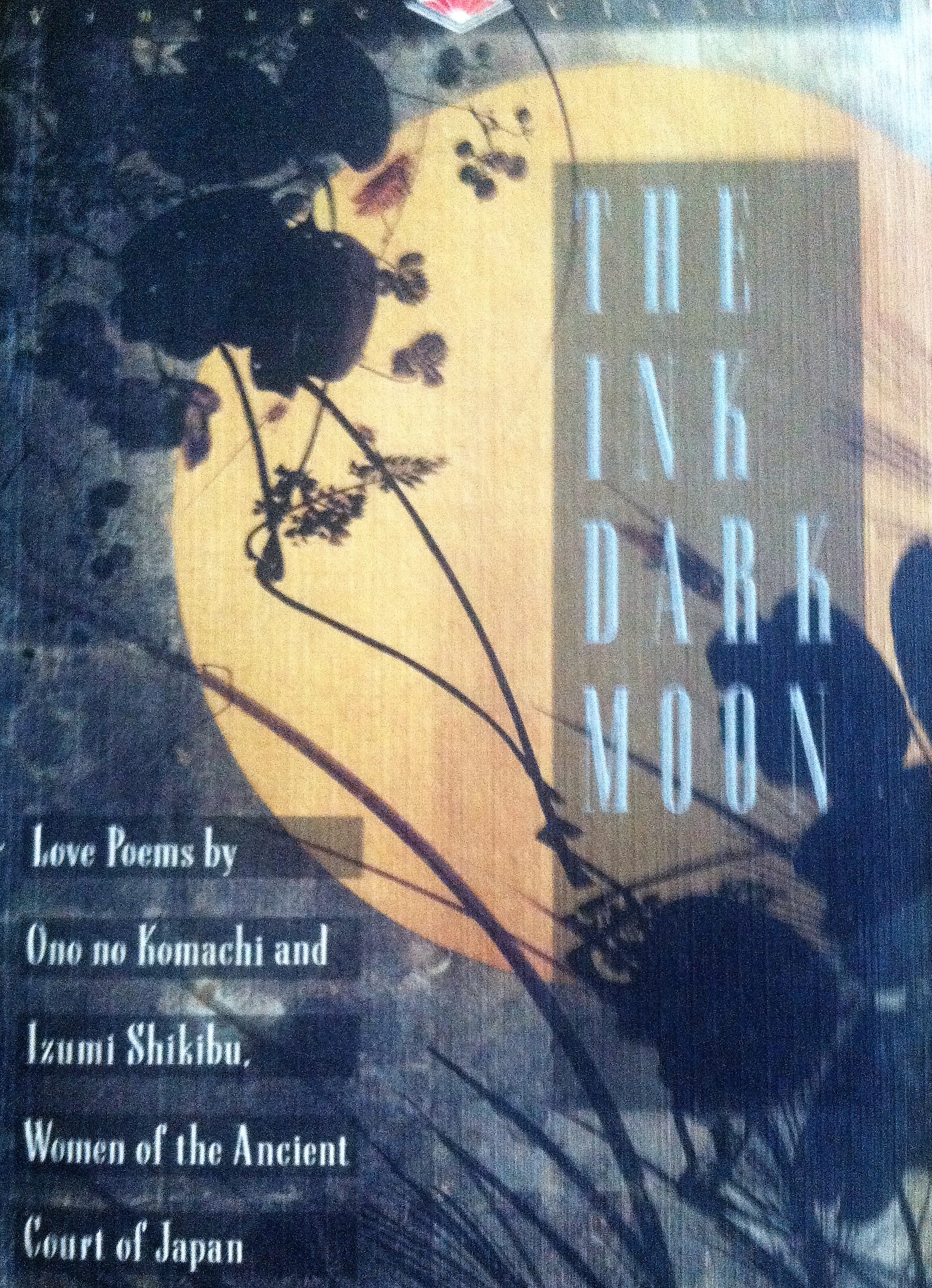
I sat down on the bank and stared at the river. Tankas came to mind, as in the ancient form of Japanese poetry: five lines, 31 syllables. I’d recently run across a discarded book of tankas written by two female Japanese poets from the 11th century. The Ink Dark Room, a collection of love poems, was truly a revelation. I basically found pure love in a garbage can. I took the book home and read it one sitting while sipping sake and one phrase from the brilliant introduction shot straight through me: the tankas were written during, “A time when poetry was ubiquitous.”

That time of ubiquity, a far away, futuristic era, sounds like science fiction, and in fact, offers up an interesting premise for a literary-themed science fiction novel. Call it Time For Tankas or The Tanka Ubiquity. Everyone communicates in five-line, 31 syllable poems. Even the politicians and dogs. Then someone comes along, a Walt Whitman or Edna St Vincent Millay type, and wants three lines and 32 syllables. The world is upended.

Reading the tankas provided me with an astonishing and timeless clarity into matters of the human heart; they seem almost supernatural in their relevance today. These two women knew love and the loss of love like no other writers I have ever read. I might also add that one of them wrote 240 tankas to her departed lover! I’m only at 25 poems to my departed collaborator, but of course, I have a few more years to go.

I looked at the river. Clyde came over for treats and nosed my pants’ pocket. I decided to compose a tanka, the first of my life. I scribbled a few lines in my notebook, made some edits, and then read it aloud to the dogs. The Sanctuary’s first poetry reading!

Here it is:

What can dogs in a river do for you?

Fetch a frosty Rainier

from the water.

Now retrieve that can

before it floats away!

(If you found this post enjoyable, thought provoking or enlightening, please consider supporting a writer at work by making a financial contribution to this blog or by purchasing an NSP book.)

July 29, 2017

Driftwood Fort Musings

Matt Love Driftwood Forts, NSP Meditations dogs, driftwood forts, forts, oregon beaches, Oregon Coast, writing

When I encounter a stretch of Oregon Coast beach where driftwood is plentiful and I don’t see a single driftwood fort, something seems amiss, unsettling.

If I have the time, and I usually do, I will gather wood and begin a fort by thanking beavers in the upper watersheds for providing much of my favorite building materials. A fort never really is completed so I can’t say I’ve ever finished one. At some point, I just stop building and walk away. Sometimes, I just gather three pieces of wood and frame a tepee or form a corral. I’m inviting collaboration from people and fort fairies I will never meet. I have made art or shelter or sheer fancy. I might be signaling an old fort friend that I dearly miss her. Occasionally, I leave a trinket behind or a pen with a little fort notepad. In the notepad, I ask visitors record their impressions of the fort. Someone always responds and the stories are often gold. Sometimes people leave behind their fort tokens, beer cans, booze bottles, doodles, shells, feathers, a little cairn, even an orange dildo once.

When someone comes across my fort, they can proceed with more building or not. They just might crawl inside and go back to the womb. I see it on the beach all the time. Perhaps no other person will see the fort. The wind and waves might collapse it, which is something I have never witnessed after building 500 or so forts in 20 years of living on the Oregon Coast. Think of that: I’ve never seen one destroyed. That’s an interesting fact to consider and possible metaphor to embrace. You only see what you create with your hands, not what is destroyed by unknown forces outside your own creativity.

I might also say that when the waves and wind destroy a fort I build, it is perfectly natural destruction. I am never angered about it.

It is my sincere hope that one day I find a great of Fort Scout Dog as Sonny the husky. I miss our building together. There is another beach dog for me though, I can feel it, and I will train him to fetch sticks for forts.

There is one fort on the Oregon Coast that very well could last forever. I like knowing that because I had a subtle hand in its construction. Yes, I know there is no place for ego in fort building. Just this once. Oh yes, and that other time when I collaborated on building the biggest driftwood fort in Oregon history. And I almost forgot: when I helped set a world record for the number of driftwood forts built in a single morning by fifth graders—19.

Over time, building driftwood forts transformed me into a visual artist, something I never thought possible of myself. The next phase is to write something precisely in the manner of how I build driftwood forts. This musing is perhaps the beginning of that method.

(If you found this post enjoyable, thought provoking or enlightening, please consider supporting a writer at work by making a financial contribution to this blog or by purchasing an NSP book.)

July 28, 2017

How to Become a Writer Part 4

Matt Love NSP Meditations, Writing howtobecomeawriter, Kafkaesque, matt love, writing

The final and most important step on how to become a writer is this: embrace the fact that you didn’t choose the subject, the subject chose you. It waylaid you. It flattened you on a lonely desert highway, like a scene from a cartoon.

You must write on this subject with pure instinct and without any regard to conventional literary wisdom. Of course, you will have read all the prison literature, but you will never emulate a single word of its various styles or themes because that would constitute utter cliché and you are no hack writer because you haven’t become a writer yet!

(Note to potential writer: never, ever, use the cliched phrase “going down the rabbit hole” to describe anything unknown, let alone the experience of belonging in The Registry. A rabbit hole by definition has a purpose and leads to a toasty warren where there are cute, carrot-chomping, furry creatures capable of nuzzling love and serving as sweet characters in children’s stories. No, that’s not The Registry at all.)

Be bold! Cut your long hair and tear down the pillars! You must consider yourself the greatest avant-garde writer on the subject of The Registry that has ever existed. Write what ever drifts through your transom. Use words like transom. Write completely without narrative structure, let alone with a coherent narrator. Go gonzo if necessary. Go William Burroughs and cut-ups. Go Oprah. Take Annie Dillard’s advice and write the book you want to read. If you have to culturally appropriate, then do it! Steal rain. Steal human misery. Steal Stevie Wonder. Line up the wheelbarrows and start hauling away as many nameless stories from the Gulag as possible.

Above all, you must take a radical approach to the material and never compromise…unless a publisher asks you to sell out. Then you will sell out and sell out fast because you need the money and because Joan Didion once wrote: writers are always selling out someone somewhere. But that’s okay—that writer is you!

It’s going to be hard, this becoming-a-writer proposition. Dedicate all remaining emotional and financial reserves into the project. Go to the brink. Go for it. Go Kafka! Go over the middle. Go into the fifth set on clay. (Note sports metaphors.)

Make this one last final stab, with everything finally riding on it, your livelihood, reputation, humanity and mortality. Give this How to Become a Writer dream everything you possibly have, but don’t be delusional either. Realize it’s probably not going to work out with this subject, because nobody, not a single person in the publishing world wants to touch it.

Touch. You just used the word touch. That was funny and morbid, in a Woody Allen-Manhattan sort of funny and morbid way. Good, keep the humor moving, put your ass in the chair, crank up the Thin Lizzy, and get to it! It’s a long way to the bottom if you want to rock and roll.

(If you found this post enjoyable, thought provoking or enlightening, please consider supporting a writer at work by making a financial contribution to this blog or by purchasing an NSP book.)

July 27, 2017

How to Become a Writer Part 3

Matt Love NSP Meditations, Writing Franz Kafka, howtobecomeawriter, Kafkaesque, matt love, writers, writing

Besides murky, menacing bureaucracies, Kafka also wrote about cockroaches. If you really, really, want to learn how to become a writer and escape The Registry, you might want to read him because he clearly foretold what being a member is all about. He didn’t write all that much, either, so it shouldn’t take that long and his books are on tape. Kafka goes well late at night, by candlelight, with tea or stout or tincture and dropping the adjective “Kafkaesque” in a future query letter might impress a literary agent who has never read Kafka, either. So bone up! And remember, Woody Allen once used the adjective to great comedic effect in one of his funny movies and that you watched an episode of Baywatch in jail surrounded by other members of The Registry and any writer worth his salt peter should be able to turn that into a humorous moment of Kafkaesque experience.

Speaking of Woody Allen, at least the late 70’s Woody Allen, it is important for you to inject humor into your story at all costs. Any kind of humor, even pratfalls. The Registry, if it is anything, is the ultimate American black French existential comedy that no one is laughing at or with because the performances take place under bridges and in windowless rooms papered with inspirational statements ripped off from exterminated Native American tribes.

The crucial third step is next. It requires your full attention and full acceptance: as soon as you join The Registry, you will be relegated, cast out, ditched, exiled, marooned, shunned, ostracized, abandoned, discarded, blackballed. Pariah status then ensues—instantly, totally. You are a full-fledged social pariah, a leper. Be forewarned, all of this unfolds in silence but it does make a sound, like a tree falling in a rain forest with no one around to hear it. That tree will eventually rot, but, unlike ecology in a real forest, the log that You Are, won’t nurse life. It probably won’t even decompose. It will petrify.

What a metaphor! Super fluid and complex! It even obliquely references a Salinger anti-hero classic! Would-be writers need complex metaphors to enrich their prose. They often provide subconscious hope for humanity in discerning readers.

The metaphor of the fallen, rotting tree may sound bleak, hopeless, terminal, but scratch beneath the moss and bark and you will discover that…there is nothing else there. The tree really is dead and not cultivating any new life. There is no ecology whatsoever in this because ecology depends on natural collaboration. Pariahs have no collaborators.

But consider this your LUCKY BREAK! Eternal status as a social pariah means eternal solitude. No partner, girlfriend, boyfriend, lover, or naturally, a collaborator. Welcome celibacy and monasticism. You’re going to be alone forever, not counting the dog. This is perfect for your writing. You also have another excellent advantage working for you: membership in The Registry means exclusion from almost every job in American society that you qualify for or interests you. Thus, a job will never pose a distraction! A real writer can’t have distractions! You’ll have all the time in the world to sit you ass in the chair (or stand up like Thomas Wolfe and Rilke) and write. There are pesky issues of eating and paying the rent, but you’re smart, creative, have an extensive vocabulary, and knowledge of edible wild foods. It will all work out somehow or you will simply die. (Be sure to make the death very poignant, verging on poetic. In the note, sprinkle in some arcane literary references, and of course, metaphors.)

(If you found this post enjoyable, thought provoking or enlightening, please consider supporting a writer at work by making a financial contribution to this blog or by purchasing an NSP book.)

July 26, 2017

How to Become a Writer Part 2

Matt Love NSP Meditations, Writing Franz Kafka, howtobecomeawriter, Kafkaesque, matt love, writing

The second step on how to become a writer, and it’s a big one, truly gargantuan, is to enroll on your birthday as a member of The Registry of Sexual Offense, the truly unique House That Kafka-built bureaucratic institution in American life that isn’t about sex at all and boasts a membership of almost one million (although no one really knows the official tally because its computed with an abacus) and keeps on growing, growing and growing. The Registry is a towering stone fortress of paranoia, digital databases, rotary phones and oppressive marginalization resting atop a granite mountain covered in dirty snow. No one can see the complex or the mountain. There is no road leading to it. Not a single investigative print or television reporter has crept inside for an expose. No mellifluous NPR voices seeking social justice. No Angela Davis fomenting for reform. No Neil Young singing a protest song. Documentary filmmakers would rather document serial murderers. Not a single aspiring writer ever belonging to the Registry has ever escaped, let alone written a published word chronicling his or her membership.

That could change with you. You might really become a writer and publish a book, although Lorrie Moore only mentions writing, not book publishing. Can you become a writer and not publish a book? Ms. Moore needs to write a sequel, but then again, she is famous and has a guaranteed publisher of her books.

Perhaps the word “Kafka” in a previous paragraph threw you off a bit. You don’t know what it means? Is it a person? An architect? A famous ball player who ate a lot of hot dogs and ran around with showgirls?

Kafka was, in fact, a writer of conspiring bureaucratic nightmares, including the expensive, endless, expanding and increasingly privatized American institution called probation, although that would be impossible because Kafka was never on probation for a sex offense in the American criminal justice system and therefore couldn’t possibly have written so accurately about it.

But he did, because he was a magnificent writer, a universal one.

Yes! Yes! Yes! Probation as a sex offender is your golden ticket into the pantheon of literary immortals where fine whiskey, awards and fellowships are served up by admiring supplicants. Your tour de force is dangling right in front you like a man swaying in a gallows with a neon-colored noose around his broken neck. Listen to it creak!

Why, you ask, this golden ticket? Because no writes for publication about probation, particularly as a sex offender. No one. There are no television shows or films about probation (except that sexy one starring George Clooney and J Lo); there are no true crime books about it; there are no thrilling novels of probation with an unforgettable protagonist who demonstrates intelligence, compassion, debonair, eccentricity or a lethal fighting skill. There are, however, shows of dumb bounty hunters and profane repo men.

Probation. Probation. Probation. How could you not write about what you observe in the weekly group meetings? The man who doesn’t exist; the man living under a bridge; the AARP man who rides a skateboard; the man with the boats and cars who lost it all to meth; the man who mends fishing nets; the man carrying around his prescription opiod and pyschotropic medications in pill bottles as his only viable for of identity; the locksmith!

And that was just one meeting! The first bestseller in this nation’s literary history with probation in the narrative mix is practically writing itself! You may even miss when probation is over. But of course, in The Registry, it is never over. Kafka got that right.

(If you found this post enjoyable, thought provoking or enlightening, please consider supporting a writer at work by making a financial contribution to this blog or by purchasing an NSP book.)

«‹ 294 295 296 297›»

Teacher of the Year: A Novella

By Matt Love

A reluctant teacher becomes advisor to a moribund high school newspaper. He meets the new editor, a dynamic 18-year-old senior, and together they begin a unique creative collaboration that revives the publication and slowly slides into gray areas. As the poet Octavio Paz wrote, “To realize itself, love must violate the rules of our world...committed by two stars that break out of the conception of love, which implies breaking away and a catastrophe..."

Teacher of the Year
Amazon's Kindle Edition $6.99

Teacher of the Year unfolds in an energetic mixture of epistle, stream-of-consciousness, narrative and meditations on the craft and alchemy of teaching. There is no other more authentic literary exploration into the agonies and ecstasies of teaching in the annals of American literature than this novella.


A Substantial but Incomplete Autobiography in Poems

By Matt Love

In perhaps the largest, most eclectic volume of previously unpublished poetry in the history of Pacific Northwest literature, Matt Love presents 148 poems written over a 30-year span.

As he writes in the introduction to A Substantial but Incomplete Autobiography in Poems, “I have organized this collection into six categories: Ocean, Love, My Life, Oregon Tavern Age, Homelessness, Probation. These poems serve as a substantial but incomplete autobiography.”

“Confessionals, odes, scatological doggerel, polemics, tankas, haiku, prose, psalms, requiems, observations, love letters, lamentations, lyrics, stream of consciousness, meditations, lists, riffs, a eulogy, a sermon, a commencement speech, found poetry, tributes, elegies. I threw it all into an ancient cement mixer and hand cranked that concrete beast while watching blue herons undulate overhead and drinking red wine as the husky snoozed in his dirt fort. The result: A Substantial but Incomplete Autobiography in Poems, something merging where Charles Bukowski, Richard Hugo, Mary Oliver and Liz Phair blend together.”

None of Love's poems were ever submitted to poetry journals, contests or magazines, making this collection a true renegade project of passion and readable to any denizen of a coastal dive bar.

A Substantial but Incomplete Autobiography in Poems

Print Edition

$21.99 + $4 Shipping


Amazon's Kindle Edition $7.99 (Free if you have Kindle Unlimited)

Recent Posts

  • Eulogy for Mark
  • Mark Leavenworth RIP
  • Roast Ruminations
  • Stand Em’in the Corner
  • Fasting Ruminations

Categories

  • Astoria
  • Bonnie and Clyde Files
  • Coos Bay
  • Corona Virus Thoughts
  • Driftwood Forts
  • Fiction
  • Lost and Found
  • NSP Correspondents
  • NSP Meditations
  • Of Walking in Rain
  • Oregon Beaches
  • Oregon Coast_History
  • Oregon Tavern Age
  • Pioneer Pride
  • Poetry
  • secret coast radio
  • Sports
  • Writing

↑

© Nestucca Spit Press Meditations Blog 2026
Powered by WordPress • Themify WordPress Themes