
Nestucca Spit Press Meditations Blog
A Blog by Matt Love
  • Home
  • About
  • NSP Categories
    • NSP Meditations
    • Lost and Found
    • Writing
    • Driftwood Forts
    • Oregon Beaches
    • Of Walking in Rain
    • Oregon Coast_History
    • NSP Correspondents
    • Oregon Tavern Age
    • Astoria
    • Fiction
    • Poetry
  • Back to NSP
  • Contact
RSS
April 13, 2017

On Zen and the Art of Motorcycle Maintenance

Matt Love NSP Meditations, Writing books, ocean, writing, writing workshop, zen

For decades I’d seen copies of Zen and the Art of Motorcycle Maintenance by Robert Pirsig in bookstores, libraries, garage sales, thrift stores, everywhere.

But I never bothered reading it until a year ago when I found a worn edition entombed in a box of discarded books ready for the recycling center. You never know what rescuing something from oblivion can do to you: dogs, cats, books, records, ideas, abandoned dairy farms, people…yourself.  That’s pretty much what I’m doing these days, rescuing myself from oblivion.

But people are coming to my aid to assist in ways I never dreamed possible. Thank you.

After finishing Zen, it instantly occurred to me that had I read this book in my mid 30s, it probably would have changed my entire teaching and (later) writing styles. I also would have derived tremendous inspiration from learning the fact that the book, published in 1974 and still in print, was rejected 121 times and went on to sell 5 million copies—a world record for a book with the highest number of rejections.

Many people reading this have read this counterculture classic. If you haven’t, you should, but not for a nostalgic return to 1974 when coffee was coffee and travelers needed paper maps and pay phones. Rather, read Zen to reappraise contemporary culture with a similar lens that Pirsig employed. You might find how shockingly modern this book sounds.

I don’t want to give too much away about Zen here, but the core of the story is Pirsig’s discursive and digressive motorcycle journey (with his troubled son) through the high country of the Western United States, including Eastern and Central Oregon, until he finally reaches the ocean in Northern California.

There, Pirsig remarks: “We round a sharp turn up an overhanging cliff. The ocean stretches forever, cold and blue out there, and produces a strange sense of despair. Coastal people never really know what the ocean symbolizes to landlocked inland people—what a great distant dream it is, present but unseen in the deepest levels of subconsciousness, and when they arrive at the ocean and the conscious images are compared with the subconscious dream there is a sense of defeat at having come so far to be so stopped by a mystery that can never be fathomed. The source of it all.”

Reading that passage almost made me stand up. I had never thought of the ocean that way because I see it every day of my life. There is no despair and defeat in me whatsoever when I visit the beach. On the contrary, I feel elation, victory and the eternal possibility of rebirth near the ocean, the source of it all.

In the last year, that feeling of a mere possibility of rebirth kept me alive, kept me writing, kept me from giving up my spirit.

I was so moved reading Zen that I developed a writing/creative thinking workshop from the experience that produced wonderful results with writers of all ages.

The workshop was based on a series of writing prompts I generated from my reading of the novel. They are below. Just meander through them as a writer, observe, recount, reflect, inquire. Stay off the metaphorical main highways of life and don’t eat in metaphorical chain restaurants. Something good will come of this journey.

Zen and the Art of Motorcycle Maintenance Prompts

  1. What is quality in your life and thought?
  2. What do you know how to fix?
  3. What do you doubt most in life?
  4. What do you have the most enthusiasm (gumption) for in life?
  5. What’s your favorite cure for boredom?
  6. Make a to-do list to improve your life:
  7. Why do people do things half ass in life? Do you? Why?
  8. What’s an assumption in American life that must be challenged? Why?
  9. Respond to this statement: “Grades really cover up failure to teach.”
  10. Is technology a “death force” in American cultural life? Explain why or why not.
  11. Where would you rather be? Riding the high country or walking near the ocean. Explain.
  12. Respond to this statement: “Cell phones have introduced ugliness and clumsiness into my actions and thoughts.”
  13. Write about one side of an American coin for 30 minutes.

Number 13 is the real electric prompt for me. Try it. Try where it takes you deep into your phony (Holden’s word) preconceived notions of all things American greatness and equality. At the very minimum, you will write, our coinage is boring. It doesn’t inspire anything except to give away these coins to people who need them to survive. I’m meeting these people all the time in my new life.

(If you found this post enjoyable, thought provoking or enlightening, please consider supporting a writer at work by making a financial contribution to this blog or by purchasing an NSP book.)
April 12, 2017

Lost and Found 5 / The Parable of the Lost Sheep

Matt Love Lost and Found, NSP Meditations jesus parables, lost and found, matt love, nestucca spit press, parable of lost sheep

Lost and Found stories abound in our culture: they characterize our books, paintings, movies, jails, furniture/vehicle restorations, counseling sessions, thrift stores, internet searches, posters of this wayward dog or that cat, and of course, our various religions and their varying definitions of Lost and Found.

My favorite Lost and Found story is from the New Testament, Jesus and the Parable of the Lost Sheep (Matthew 18:12–14) and Luke (Luke 15:3–7). In light of my recent personal circumstances, it has taken on a whole new meaning for me—I am living it.

For those unfamiliar with the Parable of the Lost Sheep, it goes like this: Jesus had an audience of tax collectors, and sinners and a couple of his detractors said, “This man receives sinners and eats with them.” Jesus responded to the criticism with a parable. “What man of you, having a hundred sheep, if he has lost one of them, does not leave the ninety-nine in the wilderness, and go after the one which is lost, until he finds it?”

Once the shepherd finds the lost sheep, he rejoices and asks his neighbors to rejoice with him. Jesus concluded the parable, “I tell you, there will be more joy in heaven over one sinner who repents than over ninety-nine righteous persons who need no repentance.”

I have a special connection to the Parable of the Lost Sheep because for almost two decades of teaching creative writing and English, I used it as a prompt, often for a semester in-class final. Students typically had 30 minutes to write a 150-word response in longhand explaining their decision in the shepherd scenario: should he leave the 99 and look for the one?

I always wrote on it, too. Toward the end of the period, we would each read aloud a representative passage from our response. The classes were usually split 50/50 on having the shepherd search for the lost sheep, with an occasional clever politician wanting it both ways, such as having the shepherd build a fence around the flock before leaving or taking them with him. In my mind, there is no having it both ways in the Parable of the Lost Sheep: the shepherd assumes risk and goes searching—or he does not.

In all those years, I never had a single student who didn’t complete the assignment or share a passage. The prompt invariably produced the most interesting writing of any given class, and I saved many of the best pieces for reasons I can’t explain. I also saved many of my responses.

One time, back in 2009 or 2010, I opened with: “Who in this world has not gone astray and found themselves lost? Lost in addiction? Lost in depression? Lost in delusion? Lost in poverty? Lost in love?”

When I have become lost during my ordeal, several shepherds left the safety and surety of their 99 and came looking for me. My older sister was one. Another was a prominent citizen of Astoria with perhaps a lot to lose by associating with me. I had my neighbor across the street and her kooky dog. There were six or seven inmates of the Clatsop County Jail who sought me out with aid during my wandering in the wilderness of incarceration. A reader of my rain book came forward out of the clouds and gray and erected a beacon.

I am lucky to have had multiple shepherds, and more may appear. It might take only one. I have learned that the shepherd has to go out and search, on foot, traversing unknown or inhospitable terrain, seeking a face-to-face encounter. It’s damn hard work and sometimes, unlike in the Parable of the Lost Sheep, shepherds fail. I am lucky mine have not and we have rejoiced together.

“Wouldn’t everyone in this class want someone to come looking for them if they became lost in body or spirit? It’s what most of you write about every day in your journal.” I wrote that ending paragraph for another response, in 2004 or 2005. Recently, it occurred to me that I have been writing on the Lost Sheep prompt for a long, long time. Today, I’m writing on it with a new perspective, urgency, understanding and desire to go after the lost people in a culture that seems to produce so many of them.

(If you found this post enjoyable, thought provoking or enlightening, please consider supporting a writer at work by making a financial contribution to this blog or by purchasing an NSP book.)

April 11, 2017

Dear Dogs of Oregon…Fight Self-service Gasoline and the Potential Loss of Treats!

Matt Love NSP Meditations, Oregon Coast_History dog treats, dogs, oregon, oregon history, oregon legislature, self-service gasoline

Dear Dogs of Oregon:

My name is Kali. I am an easy-going black and brown dog that hails near the ocean. I am writing to alert you about an ominous political development in the Oregon Legislature that could have dire consequences for our future. I write with the intention of rallying us all to a great cause.

That cause is treats!

The aforementioned development is a proposed bill to increase self-service gasoline in Oregon. Do you know what that portends, my friends? Let me tell you: the spread of loathsome self-service gasoline means disappeared station attendants, which means no treats for us when our owners’ vehicles need refueling and we bound along for the joyful ride, often with our heads out the windows, tongues rolling wild.

Here is the cruel reality of self-service gasoline: No treats! No goofy greetings! No special scratches! No inquires about our lovable or annoying characteristics. Not even the occasional surprise high of a pot-laced treat given by mistake! Self-service will also lead to the terrible loss of close friends at our regular station or a one-time acquaintance with a working class man or woman in the hinterlands. It means the loss of a unique Oregon quirk that either delights or vexes a visitor but that all dogs love.

What is happening to Oregon?  We dogs want to know!

House Bill 2482, which allows 24-hour self-serve fuel on most counties in Eastern Oregon, passed unanimously in the House last week and is now scheduled for consideration by the Senate. Rep. Cliff Bentz, R-Ontario, introduced the bill and claimed in an interview, “The bill affects 5 percent of Oregonians.”

This is the incremental Beginning of the End for dog treats at gasoline stations in Oregon because in a few years, there won’t be anyone employed to give them out. Representative Bentz thought we weren’t paying attention. He was wrong. If he has a dog, he should have consulted it first. Bad law!

According to a news account of the legislation’s debate, Rep. Paul Evans, D-Monmouth, said the purpose of the bill is to make sure that people are not stranded in remote areas. “This is not an endorsement of self-service state-wide,” he said, of House Bill 2482.

Sure it is. It has already begun and it creeps west, into the rainy heart of Oregon.

Should this heinous bill pass the Senate, and it probably will, and should Governor Brown sign it into law, and she probably will, I predict within a short time, the total end for our happy canine way of road-trip life.

I might also add that this law will eventually lead to the total end of something else, something truly terrible for our owners—the ability to strike up a conversation with the folks who fill the tanks, a conversation that often ensues because of our excitable reactions to the prospects of treats ingrained in our memories. We never forget the face of our favorite treat men and women!

These conversations, mostly about dogs, but often about rain, restaurants, and better directions when smartphones miserably fail, are good for humans and they need more of them, just like I need treats at the gas stations. They make us all happy.

Sincerely,

Kali

(If you found this post enjoyable, thought provoking or enlightening, please consider supporting a writer at work by making a financial contribution to this blog or by purchasing an NSP book.)

April 10, 2017

Lost and Found 4 / Improvisation with Monk and Coffee

Matt Love Lost and Found, NSP Meditations, Of Walking in Rain, Poetry Astoria, jazz, lost and found, matt love, Monk, Oregon Coast, poetry, rain

When you become lost, what do you do? You can plan or you can improvise. You can call for help or give up. You can lose your cool or scratch moss on the trees and figure it out. Choices abound. In my ongoing presence in the Territory of the Lost, I’ve had to improvise and improvise on the move through bottomless landscapes I never knew previously existed.

Before, I always had been a planner: lessons, lists, books, book tours, relationships, death. Now I have to improvise everything on a metaphysical plane in order to rebuild my life because physical improvisations are impossible in the Registry of Sex Offense and can land you back in jail. If that doesn’t make any sense then you understand perfectly and have an intuitive grasp of Franz Kafka’s novel The Trial even if you’ve never heard of it, let alone read it.

There is no planning in my life anymore although I have to complete written Action Plans asking/justifying for permission to move with specific purpose in public. I am basically filling out worksheets to live. You can’t improvise with worksheets, which is why I never used them in my former teaching life.

As I said, my ability to improvise has moved strictly to a metaphysical plane and I have found that place extremely rich in creative possibility. Take the poem I wrote a Thursday morning in Astoria a few weeks ago from my Beaverwood Studio. It was the first poem I’ve written in three years. The last one I wrote changed my entire life for the better, exponentially better, with real tangible outcomes.  Maybe this poem will succeed as well, and magically pull poetry down from its obtuse plane and into the reality of busting up all our concrete planning and conventional wisdom. Busting up, I like that aim for poetry.

But if I planned that outcome for this poem, then it is dead. It simply will improvise with the reader’s mind.

Thelonious Monk and Cold Coffee

The sun came out

after three weeks of rain.


I drink cold,

two-day coffee,

in the parlor,

the Beaverwood Studio,

listening to a tape of

Monk Alone in San Francisco.


I am alone in Oregon,

waiting for rain

to return and deliver

what I can’t possibly expect

but hope I deserve.


I’m writing this in longhand,

with a pen from an Indian casino.


I’m writing this in a journal

some nameless woman

discarded in a garbage can.


In that journal

she confessed

a suicide attempt.


She wrote: “Almost exactly one year ago, my story began in a bathtub full of tepid water, piss, and my own blood.


She no longer has her poetry

of that moment.


That phrase…almost exactly.

An apparent contradiction.

What is almost exactly?


I hear a chainsaw in the distance.

Can you chainsaw like Monk

plays the piano?

Probably not this chainsaw,

but I’ve seen it before,

in Reedsport.


Don’t you see how this poem is written

in rhythm with Monk’s piano?

How he plays the piano.


Without improvisation, It will never work.

(If you found this post enjoyable, thought provoking or enlightening, please consider supporting a writer at work by making a financial contribution to this blog or by purchasing an NSP book.)

April 9, 2017

On the End of My Classroom Teaching Career

Matt Love Astoria, NSP Meditations matt love, Oregon Coast, teachers, teaching, writing

It’s a strange feeling holding the official termination of your teaching career in your hand. But here it is, the Letter I still can’t bear to open and read but know its contents. The End.

The general impression is that I concluded my 32 years in service to the young people of Oregon (and one year in Turkey) in abject disgrace. I will address that impression at a later date, but not in this blog. There will be time for that later.

As for teaching, I do miss the unique chemistry I had with the students from Astoria. They were unlike any of my career, beautifully gritty and unpredictable. We were doing great things together. We were going somewhere special and now I am going somewhere unknown.

I admit that I had an ongoing love/hate relationship with being a middle/high school teacher; I’ve written about it a lot. Teaching so often consumed me that I couldn’t eat, couldn’t sleep, couldn’t participate in a reciprocal relationship with partner, couldn’t get the job out of my head, couldn’t ever truly relax or live in the moment. I’ll never forget that one bout of insomnia in 2012 when I was arriving to my classroom at 4:00 a.m. in the morning! I do know that I gave the various jobs everything I had, I mean everything, because it was the most important work of my life.

It was pretty harrowing for me to dump three decades of curriculum I wrote into a recycling bin. (I retained a few writing units.) I’ll never forget that rainy morning in Seaside a few months ago. I felt as if wanted to join the files. Before I tossed each file, I quickly perused its contents and was astonished to discover lots of personal writing from 5, 10, 15, 20, 25 years ago that I had completely forgotten about. It was my writing on the various prompts I gave them over the years. I must have written a half million words with students in real time, right in front of them. I have often thought I trained myself as a writer by writing with students. I became part of the process and surrendered my work over to their critique like they did with theirs. Over the years, many of the students were the best editors I ever had, including one in particular who went on to copyedit four of my books and had an intuitive grasp of how to coach me to say things more clearly. I dearly miss working with her.

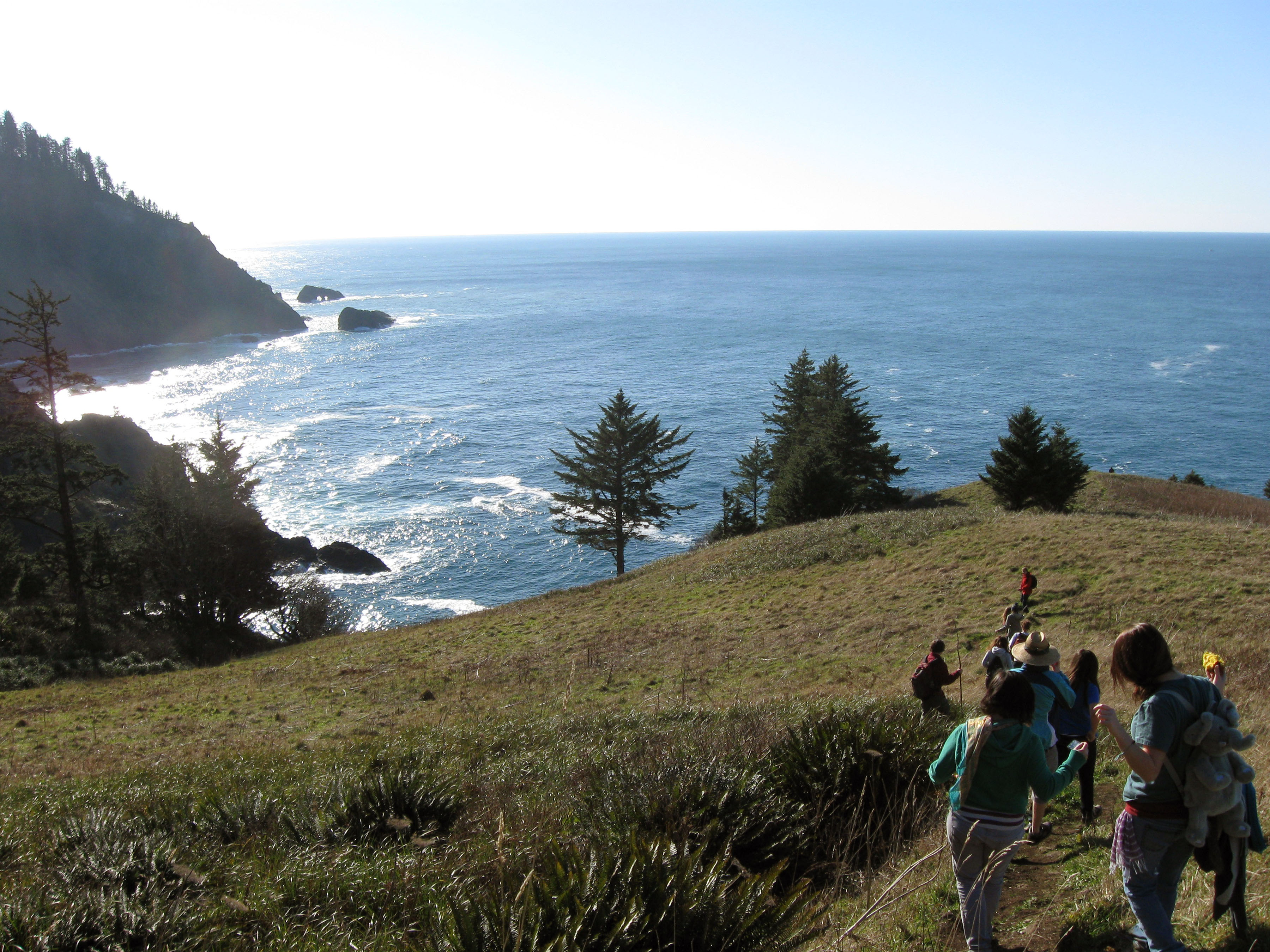
For my own mental accounting, here is a list of all the subjects I taught, sports I coached, and extracurricular activities I advised. This list doesn’t include the couple hundred times I was a substitute teacher or the hundreds of field trips I led, at least 27 that involved building driftwood forts, one that took place in 4.75 inches of rain, a dozen or so to a thrift stores, and seven to Powell’s Books in Portland. Perhaps my favorite was the hike to Hart’s Cove (pictured here.) What a glorious Oregon morning that was.

Subjects: Beginning Psychology, Advanced Psychology, Political Science, Advanced Political Science, World History, American Government, Economics, Global Studies, Freshmen English, Freshmen Journalism, ESL for fifth graders, ESL for high school students, US History, Journalism, Advanced Economics, Creative Writing, Advanced Creative Writing, Photography, Advanced Photography, Advanced Freshmen English, Advanced Junior English, Senior English, Yearbook, Seventh/Eighth Grade Language Arts, Seventh and Eighth Grade Social Studies, Seventh and Eighth Grade Science, Seventh and Eighth Grade PE, Fifth and Sixth Grade English, Junior English, Advanced Senior English, WR 121, English Credit Recovery, Alternative English, Rock and Roll.

Sports: fifth grade girls basketball, seventh grade boys football and basketball, freshmen girls basketball, varsity girls tennis (six years), varsity boys tennis, eighth grade girls basketball, 10 years of teaching summer tennis lesson to students age 8-18.

Activities: newspaper advisor (12 years), literary review advisor (11 years), open mic advisor (8 years, 125 gigs) rock festival coordinator (four years), service club advisor (three years), mushroom club advisor (one year), Oregon adventure club advisor (one year.)

I am sure I forgot something here or there. This is all from memory and it’s been a long journey through a lot of different jobs and so many different experiences. I met some of the greatest people of my life during this journey as a classroom teacher. I had some favorite classes, but if I was hard-pressed to name the top ones…it would be…the Advanced Junior English class from Taft in 2005-06 and the Legion of the Rock creative writing class from 2012. There was also an Econ class at Beaverton that stands out.

That part of my life is over and my reputation as a teacher forever stained. But I know I did some good work that mattered.

Still, I believe I have something unique to offer Oregon and Oregonians with my teaching, particularly in light of what’s happened to me. I will continue to teach writing workshops to adults and perhaps expand that to the online world. I would like to start a writing group and lead in that capacity. My ultimate teaching job would be to teach writing to the incarcerated, men or women, all kinds of writing, from resumes, to letters of apology, to memoirs, to poetry, to flash fiction. During my ten days in jail, I taught an informal writing workshop to several of the inmates, and the experience taught me a lot and produced some incredible words. There is more work for me to do, especially when it comes to honoring the faith my family held out to me during the ordeal. They never stopped believing in me and that keep me believing in myself.

For now, patience. We shall see what unfolds. I’m getting stronger every day.

Wait until I get a dog.

 (If you found this post enjoyable, thought provoking or enlightening, please consider supporting a writer at work by making a financial contribution to this blog or by purchasing an NSP book.)

April 8, 2017

A Siddhartha Lesson for the Former Teacher

Matt Love NSP Meditations, Writing herman hesse, nestucca spit press, Oregon Coast, rain, river, siddhartha, teaching, zen

I taught English and Rock and Roll on the Oregon Coast for almost two decades until my career came abruptly to an end.  One of the highlights of this job was teaching Herman Hesse’s Siddhartha, a book suffused with Buddhist thought and ideals that was almost universally read by high school students in the 1960s and 70s, but has since fallen deep out of favor, nearly into the curricular abyss. I was happy to lead a tiny resurrection of this novel for young people in my rainy corner of the world, but have had to let all of that go.

Letting go. That’s one of the central powerful yet agonizing themes of Siddhartha. What must a person let go in order to end his suffering and transcend to something more enlightened?

I am living that agonizing theme now, and Siddhartha has taken on a whole new meaning. I am not teaching the book to high school students on the beginning of their journey into adulthood; the novel is teaching me in the middle of middle age. I think it might be kicking my ass—in a good way.

For those of you not familiar with the novel, it unfolds the story of a privileged young man named Siddhartha who renounces his family’s wealth and prestige and spends his entire life trying to find answers to life’s eternal vexing questions. In his quest for truth, Siddhartha follows several paths, extreme poverty and asceticism, then pleasure and material acquisition. He learns the root of all human suffering, the importance of letting go, and the value of seeking answers not from books, teachers, creeds and traditions, but rather through direct experience, self introspection and intuition. At the end of his life, after suffering and losing everything, he settles near a river with a wise old ferryman and begins to listen to the river. There he learns that one thing and reaches the enlightened state of Nirvana. Hesse writes:

Siddhartha tried to listen better. The picture of his father, his own picture, and the picture of his son all flowed into each other…They all became part of the river. It was the goal of all of them, yearning, desiring, suffering; and the river’s voice was full of longing, full of smarting woe, full of insatiable desire. The river flowed on towards its goal. Siddhartha saw the river hasten, made up of himself and his relatives and all the people he had ever seen. All the waves and water hastened, suffering, towards goals, many goals, to the waterfall, to the sea, to the current, to the ocean and the goals were reached and each one succeeded by another. The water changed to vapor and rose, became rain and came down again, became spring, brook and river, changed anew, flowed anew.

I can’t think of more beautiful passage in all of literature about the wonder of the water cycle and how human beings belong to it. Really, when I was teaching Siddhartha, I believed all the healing and clarifying answers of the world were contained within watching a river flow. I used to assign students the task of sitting near a river, watch it flow, and record their stream-of-consciousness in their journal while doing so. They all did it without complaint. Who really doesn’t want to watch a river flow and figure it out? Prisons and jails should have views of a river. It they did, the rate of recidivism would certainly go down. It’s so obvious.

During the course of teaching the novel, I had students write on prompts I generated from my reading of the novel. These prompts never failed to elicit some of the most beautiful and terrifyingly honest examples of personal writing I ever read from teenagers.

I will miss reading their responses. They inspired me to teach with all my heart. We were in the fray together. Or, more accurately here on the Oregon Coast, the scrap. I scrapped for my students.

Recently, in a moment of crisis during my ongoing navigation through the black Registry of Sexual Offense, I returned to Siddhartha and the journal prompts with no expectations of clarification or healing. I only wanted to respond in concert with a river and see where it took me. I would go anywhere the river of reflection desired, perhaps to eddies, perhaps through rapids, perhaps into slack water and utter stasis.

I walked the steep wooden stairs on the back property of my home, to a platform with a real estate agent’s view of the Columbia River, a watercourse merging into Youngs Bay, watersheds upon watersheds, flowing, coming together, moving downstream, to the Pacific Ocean, the greatest force on the planet and not one elected politician in American knows it.

It was overcast. Rain threatened, but I would stay dry thanks to a canopy of hemlock branches overhead. I sat down on the platform with a list of the prompts and responded to:

  1. What experience in life taught you the most?
  2. What’s happening too fast?
  3. What’s your greatest desire?
  4. What causes you suffering?
  5. What do you one day hope to learn about yourself?
  6. What’s been the lowest point in your life?
  7. What’s the one attachment you need to release in order to get wherever you want?
  8. What distracts you?
  9. How does a person obtain wisdom?
  10. Who or what do you go to for answers to life’s hardest questions?
  11. What do you need to be patient about?
  12. Leaf or star? Which one are you?
  13. What guides you on your journey in life?
  14. Describe a moment of perfect clarity in your life.
  15. Describe a time you listened.
  16. What’s the hardest thing in life to do?
  17. Describe a time you did/didn’t give up on someone or something.
  18. What can you learn from watching a river flow?
  19. What did a teacher teach you that became valuable?
  20. What’s your greatest gift to the world?

The exercise took about…I lost track how long. I found different implications in the length of an hour. The familiar durations had changed. What is time when you are waiting like Siddhartha? I am waiting now. If you remember the book, that’s how he triumphs.

I will refrain from sharing my responses at this time. The time isn’t right yet. It will be one day.

(If you found this post enjoyable, thought provoking or enlightening, please consider supporting a writer at work by making a financial contribution to this blog or by purchasing an NSP book.)

«‹ 311 312 313 314›»

Teacher of the Year: A Novella

By Matt Love

A reluctant teacher becomes advisor to a moribund high school newspaper. He meets the new editor, a dynamic 18-year-old senior, and together they begin a unique creative collaboration that revives the publication and slowly slides into gray areas. As the poet Octavio Paz wrote, “To realize itself, love must violate the rules of our world...committed by two stars that break out of the conception of love, which implies breaking away and a catastrophe..."

Teacher of the Year
Amazon's Kindle Edition $6.99

Teacher of the Year unfolds in an energetic mixture of epistle, stream-of-consciousness, narrative and meditations on the craft and alchemy of teaching. There is no other more authentic literary exploration into the agonies and ecstasies of teaching in the annals of American literature than this novella.


A Substantial but Incomplete Autobiography in Poems

By Matt Love

In perhaps the largest, most eclectic volume of previously unpublished poetry in the history of Pacific Northwest literature, Matt Love presents 148 poems written over a 30-year span.

As he writes in the introduction to A Substantial but Incomplete Autobiography in Poems, “I have organized this collection into six categories: Ocean, Love, My Life, Oregon Tavern Age, Homelessness, Probation. These poems serve as a substantial but incomplete autobiography.”

“Confessionals, odes, scatological doggerel, polemics, tankas, haiku, prose, psalms, requiems, observations, love letters, lamentations, lyrics, stream of consciousness, meditations, lists, riffs, a eulogy, a sermon, a commencement speech, found poetry, tributes, elegies. I threw it all into an ancient cement mixer and hand cranked that concrete beast while watching blue herons undulate overhead and drinking red wine as the husky snoozed in his dirt fort. The result: A Substantial but Incomplete Autobiography in Poems, something merging where Charles Bukowski, Richard Hugo, Mary Oliver and Liz Phair blend together.”

None of Love's poems were ever submitted to poetry journals, contests or magazines, making this collection a true renegade project of passion and readable to any denizen of a coastal dive bar.

Amazon's Kindle Edition $7.99 (Free if you have Kindle Unlimited)

Recent Posts

  • Mark Leavenworth RIP
  • Roast Ruminations
  • Stand Em’in the Corner
  • Fasting Ruminations
  • Scenes from Two Weeks of Early Morning Homelessness in Empire

Categories

  • Astoria
  • Bonnie and Clyde Files
  • Coos Bay
  • Corona Virus Thoughts
  • Driftwood Forts
  • Fiction
  • Lost and Found
  • NSP Correspondents
  • NSP Meditations
  • Of Walking in Rain
  • Oregon Beaches
  • Oregon Coast_History
  • Oregon Tavern Age
  • Pioneer Pride
  • Poetry
  • secret coast radio
  • Sports
  • Writing

↑

© Nestucca Spit Press Meditations Blog 2026
Powered by WordPress • Themify WordPress Themes