
Nestucca Spit Press Meditations Blog
A Blog by Matt Love
  • Home
  • About
  • NSP Categories
    • NSP Meditations
    • Lost and Found
    • Writing
    • Driftwood Forts
    • Oregon Beaches
    • Of Walking in Rain
    • Oregon Coast_History
    • NSP Correspondents
    • Oregon Tavern Age
    • Astoria
    • Fiction
    • Poetry
  • Back to NSP
  • Contact
RSS
June 7, 2017

“Soul Train Rollin!”: Paul K and the Greatest Get Down Block Party in Oregon History

Matt Love NSP Meditations, Oregon Coast_History, Sports Bill Walton, block party, Maurice Lucas, North Portland, oregon history, Portland, portland trail blazers

Today, June 7, 2017 marks the 40th anniversary of the largest public gathering in Oregon history: the downtown Portland celebration one day after the Trail Blazers won the NBA championship that attracted 250,000 people.

 I missed it all, by not skipping school in seventh grade at Gardiner Junior High in Oregon City. I’ve documented that sad story in my 2007 book, Red Hot and Rollin’, an anthology of essays, memoirs, primary sources, oral histories and photographs, that commemorated the championship.
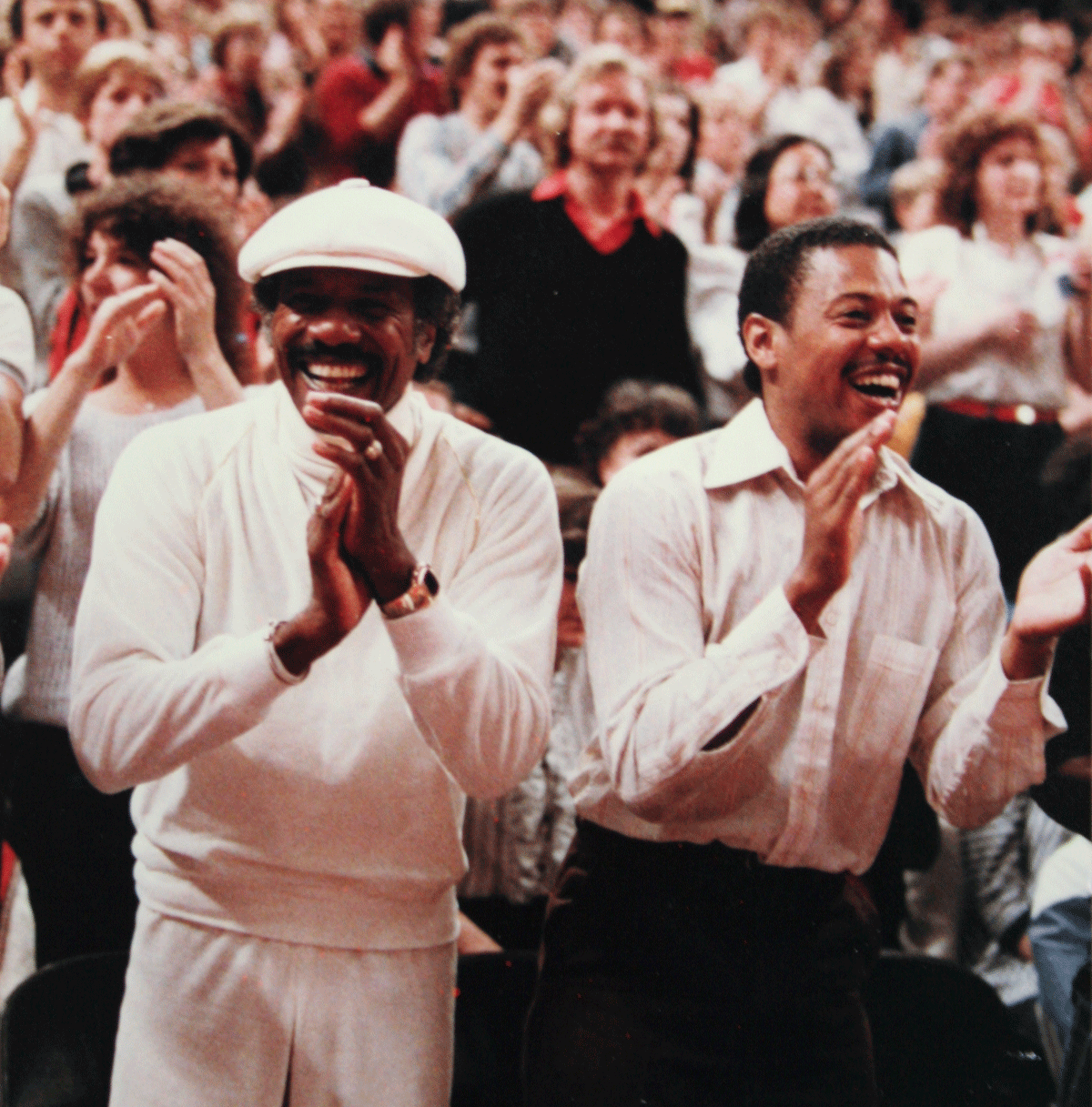
 One of the oral histories was of Paul Knaals (pictured on left), a legendary figure in Portland’s African American community (still alive at 86 years old), who ran a nightclub called Geneva’s on Williams Ave. in 1977 and staged a legendary block party after the championship parade. His story of his incredible connection to the team from its founding in 1970 through that championship season was a highlight of the book and important, but overlooked part of African American history from that era. Paul was incredibly gracious with me during our interview at his hair salon, in the summer of 2006. I’ll never forget when he brought out the photo album, too. I put many of these mind blowing images in the book, but unfortunately, only in black and white. Well, in honor of that magical day 40 years ago, here is a reprint of Paul’s oral history, and some of photographs. Get down on this! Spread this post please. Even if you don’t like professional sports, read this and know this story isn’t really about sports. 

Tickets

I bought my season tickets when drafted Walton in ’74 but before that I went to the games for free. When the team started in ’70, I went to (General Manager) Harry Glickman and says, ‘I run a club called Geneva’s and if you give me four tickets for every game I’ll bring some people to the game, every game. Get them interested. I could bring different people to the game and introduce them to the team.’ So he gave me four tickets. The seats were empty back then so why not?

In ‘72 he cut it to two. In ‘73 he gave me a press pass so I would sit down on the floor with the regular press guys, and bring my camera. Sometimes I wouldn’t even have film in the camera! In those days I would just sit with my legs crossed and pretend I was taking pictures. It didn’t matter. I just wanted to be at the game. Then they drafted Walton and that’s when I got my season tickets, in the second row, behind the basket. I knew getting into the game was going to be tougher.

Geneva’s

I purchased Geneva’s in 1968. My wife and I did. It was called Bess.’ We changed the name to Geneva’s. I named the club after my wife, Geneva. We went in and started our operation. We did some remodeling. Put down new carpet. It became popular, very popular, very fast. The Blazers were pretty popular with the black community in those days because the guys came around to the club. All the fellas would come around and people got to know them and that made it okay. Tanqueray really took off at this time. Tanqueary with grapfruit juice or Tanqueray straight. I went through tons and tons of the stuff that year. It was always Tanquerary. I don’t know if people just liked to say it, Tanquerary, sounds nice, don’t it?

We had another night club called the Cotton Club. And I had another bar named Paul’s. So I had three bars on this side of town with three distinctly different clienteles. The swingers went to Cotton Club. The working man went to Paul’s. And the uppity ups came to Geneva’s. I had to have a little dress code in Geneva’s.

Bill Walton

The dress code went well until Bill Walton started coming in. He was a hippie and all of his people were hippies and they would come in dressed any old way. He started coming in the second year he was in town, the year he was hurt. That’s where he hung out, at Geneva’s. I had seen Bill at practice, been watching him after he got hurt, and I said, ‘Bill, I got a bar called Geneva’s and nobody ever heard of a bone spur. You come in there, and it will be a situation where no one will even talk about basketball. They just want to talk with you.’ Two weeks later, I was back in the office and my barmaid called. Ruby says, ‘Mr. Knaals, there’s a reeeeeeal tall red headed white guy out here…’ I knew it was Bill and I went up to him and said, ‘Hey Bill. how you doing? Welcome.’ He had put on some weight, probably 240, because he wasn’t playing. So I introduced myself again and we talked a bit. And then later that night he came back in with 8 or 10of his people, hippie people, with all their backpacks. It was they who started all this backpack stuff. Everyone got one now.

So Bill came back and everyone says, ‘How come we got to dress when they don’t have to dress?’ So I says, ‘I guess you don’t have to dress no more because this is Bill Walton’s spot now. He ended the dress code! Bill drank Budweiser. That’s why he got that gut. No hard alcohol at all. He used to ride his bicycle over to the club in the day time. The black community loved Walton. They never gave it to him about not playing like the news media and white people did.

Geneva’s Soul Express

Well, the story of the Geneva’s Soul Express is, there was a bar on 14th called the Pantry and the owner had a bus, a little one like what carries senior citizens around today, and he was taking people to the games. I called him and asked him how the bus thing works. He says, ‘It’s the greatest thing in the world. Everybody comes in the bar, has dinner first, then rides to the game, then comes back, drinks.’ So I was watching this old bus on the lot at Coast Janitorial Service and went in and says, ‘Mr. Scott, you don’t really use that bus, how much you want for it?’

‘$1500.’

‘Okay, I am going to go get the money and you have the title ready for me when I get back.’

So I got together $1000 and I came back and says, ‘Mr. Scott, I got your money.’

‘Okay, Paul Knaals, count it out!’

So I count out ten $100 bills. He says, ‘Where’s the rest?’

‘Mr. Scott, you haven’t used that bus in two years. It’s just sitting on your lot. I got the money right here.’

‘Paul Knaals, you are too much! Okay.’

I had it painted up, and put the name Geneva’s Soul Express on it. I drove it every night of a game. I left work early to go home and change, then I’d pull up to the bar in the bus and call out, ‘Soul train rollin!’ and everybody would get up and go out there. The bus carried 28 people and was always full. I would pull the bus right up in front of the Coliseum, then park. There were only a couple of buses at first doing this, then four, then five, then more. Then a guy out who owned a club out on 82nd called up and asked how it all worked. So I told him. He got a bus, painted it the same color as mine and called it the Harvest House Express. Then one night, we got on our bus after the game, and there was this white guy sitting there, backing the back, and I took off, and we got half way to Geneva’s and he says, ‘You know what driver? I think I got on the wrong bus!’ I says, ‘Too late now brother, we not stopping til we get to Geneva’s! So he came in. He had fun, man did we have fun in Geneva’s that night. And I finally says to him, ‘You need  a ride? He says, ‘Yeah.” So I got my car and gave him a ride home out near 82nd. After that, every now and then, he would just come to Geneva’s and park his car and he’d ride down with us and ride back.

The Playoffs

I traveled with my wife and some other people to the away playoff games. At Denver, when David Thompson missed those two free throws to send it into overtime, we were beating on the air conditioning ducts because we were way up top and you could hear the ducts, that pounding sheet metal sound. It was all you could hear.

Once we beat LA four in a row, I knew we were rolling.

When they played the championship series, I got a call and they said we’re going to Philadelphia for the games, so we signed up to go. And we got out of Portland on Thursday morning, the game was Thursday night. We lost that game and then the  next one on Sunday. And everyone there was saying, ‘You guys are from Portland right? Answer me this: Why you fly all the way here, all that way, and you lose?’ So I started making some bets, in a bar we were at. I says, ‘Hey we’re going to win the championship. I can guarantee you that!’ So I start making drink bets.

When we flew back to Portland after the second game, the Philadelphia team was on the same plane. Dr. J, Darryl Dawkins, and all the guys, and when we got in that night, Dawkins came into the club. He was only about 19 at the time but I wasn’t going to kick him out. So I says, ‘Darryl you can’t drink.’ No I know he’s going to drink but I got to tell him anyway. So I had a little guy who was my doorman, and he was about 5’ 7,” kind of stocky, and I says, ‘Tim, I want him (Dawkins) out of the bar. He’s too young to be in here. I want him out of the bar.’

‘Which one?’

‘That guy in the corner.’

So he goes over to look at him and he comes back and says, ‘Mr. Knaals, you mean that big guy over there in the corner?’

‘Yeah, I want him out of here.’

‘I’m sorry, I’ll just have to quit my job because I can’t put him out.’

‘That’s okay Tim, that’s Darryl Dawkins and he plays for Philadelphia. I was joking.’

Dawkins tipped someone $20 that night, which was like $500. A lot of Sixers came in during the series. Even Dr. J.

The Party

The night before game six, I knew we were going to win, so I’m thinking, ‘We are going to need some barricades because I am going to barricade the street (Williams Ave)’ So I went down to seventh and Knott and they were doing some construction, and I took two barricades that weren’t going to be dangerous to anyone if missing from the construction site. I came down with the truck and loaded them up.

Everybody knew that if we won, there was going to be a party at Geneva’s. After the game, I came to the bar and the street started getting full and I put the barricades up. That was about three o’ clock? I did it myself. About 3:30 or 4, Mayor Neil Goldschmidt came by and he couldn’t get through. He was coming up to the club. And I went down and says, ‘Neil, how out doing? C’mon through.’

‘Paul, what are you doing with these barricades up here?’

‘Neil, you don’t want cars going through here. Look at all these people on the street!’

So he gets on a radio and called down and told the police to get some more barricades out here. He didn’t want anyone getting killed.

There was a party planned downtown but nobody went there. They came to my place. Then the media found out and all the television stations showed up. We opened up the street to let them come up and they got to partying and then asked us to whoop it up whenever they started filming. Everybody was screaming.

The night before I had a guy, he called himself Mr. Sweet Meats, set up for food. I says, ‘If we win the championship tomorrow, if you set up and we don’t win, I’ll pay you $25, and if we win, you’re on your own.’

And we won and people were out on the street buying everything. I had Mr. Sweet Meats selling hamburgers, hot dogs and sausages. We had another stand with popcorn. One woman had cooked a roast for Sunday dinner but she just came down and cut the roast up with bread, mayonnaise and sold sandwiches right there on the street.

There was a church just adjacent to Geneva’s on the next block, so when church let out, they just walked right over and started partying. A friend of mine, Lloyd Allen, was into music. And he had his friend bring a RV down, and they set up some music on top of it. People were out in the street dancing the Blazermania, you know, when you put your hands over your head and spin them like Walton used to do on the court. I had a couple of go go girls too, doing the Blazermania all over. They were Miss Rip City and Miss Blazermania.

Corky Calhoun showed up first. Then Luke came. Lloyd Neal came. Later that evening, Lionel Hollins. Then Johnny Davis. Herm Gilliam. Harry Glickman came with his wife and daughter, who was six years old. Coach McKinney and his wife came.
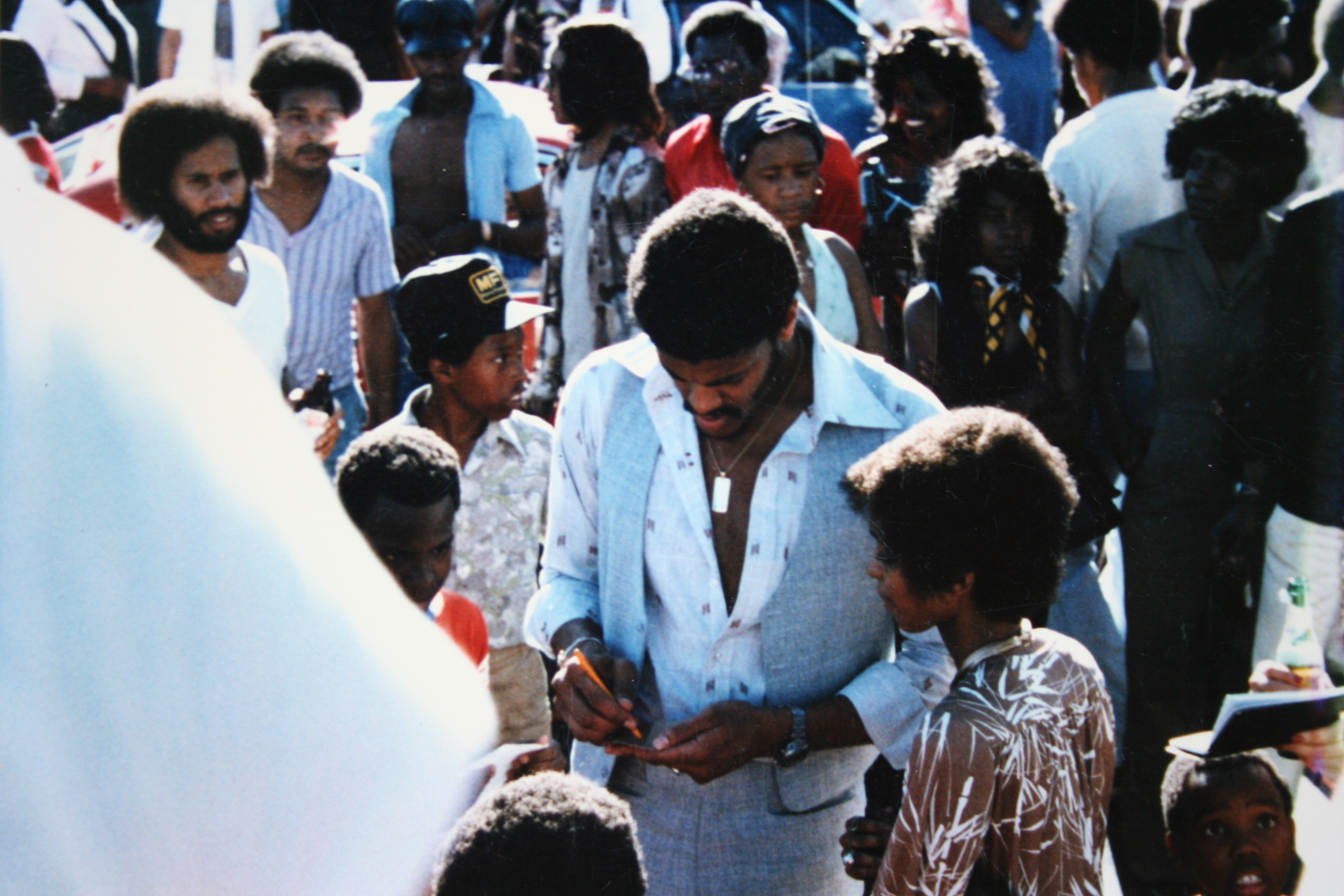
There was more action in the street but it was happening in the bar too. We couldn’t serve fast enough. I was behind the bar and couldn’t keep up with the drinks. And we were able to sell every beer that we had cold or warm. We was giving them a hot beer with a glass of ice. It was the only time my wife ever worked at the bar in all the years we owned it.

We had no trouble at all. All I was doing was every once and awhile I would take the money in a sack and put it into the safe. I took it out about six or seven times. We made about $6500 that day. What a take. Drinks were 75 cents or a dollar. We were rolling. I mean we were selling the beers distributors had given us that nobody wanted, mostly ales, and we got rid of every old bottle of ale from the basement. Everything was gone. What a day.

We had a couple of guys park their motorcycles on Williams Ave. and they just walked on through. The Gypsy Jokers were right down the street, that horrendous gang back then that traveled around. I never did find out if these guys were Jokers but they looked like it. They came in and started jamming just like everybody else. The title put Portland on the map. No one had ever heard of us before. The party here went into the early morning.

Permit? What permit?
June 7, 2017

NSP Correspondent / Matthew Sproul / Cross Current

Matt Love NSP Correspondents, NSP Meditations

(NSP Meditations features regular contributions from Correspondents. If you are interested in becoming one, contact Matt Love through the NSP web site for more details.)

In late spring I am out walking in my Hosford-Abernethy neighborhood in southeast Portland near 21st Avenue. Heading west one mile from the Willamette River. The hills beyond it rise so quickly; so close; so clear. I look towards the circular appearing cluster of modernist houses in Portland Heights, above Broadway, with their cherished vista of Mount Hood; the Jewel of Oregon, still gloriously encased in icy white.

I’m fine here, with my short range perspective. Those hills (properly Tualatin Mountain) are reassuring to me, a protective wall in three dimensions.

I’ve reached my first turn, to the right, due north. In short order, moving beneath a slender maple tree, for the first time this year I catch the sound of a breeze through the leaves. I feel soothed and a little taken aback, as though having been told a secret. The leafy months have arrived and I may be, it seems, among the first to know.

Though the sound is new, for some time now I’ve been alert to today’s telltale blow from the north. Each year around April 15th, Portland’s prevailing winds shift from southeast to northwest; and around October 15th, vice versa. In each instance making a 180 degree about face; hewing always to a single diagonal axis relative to the local east-west street grid.  It is a 45 degree cross current, winter and summer. By way of example, if on a June day of northwest winds I travel west towards downtown, say along Clinton Street, I feel direct wind only on the right front area of my face.  Heading home, airflow only lands squarely on the left rear of my coconut. It’s bracing going in, a nudge coming back. Cool. Western Oregon’s northwesterly flow defines our summer. Turn to it; feel that enlivening, faithful gift direct to you from the mighty Gulf of Alaska.

Going, as it were, beneath this newly leaved maple, I’ve caught the season’s opening act. Yet already, amidst my revelry, my thoughts shift to the inevitable selfsame airflow through the older leaves of nearby 100 foot treetops—an unmistakable signal of the approach of summer’s end.  It marks not only the close of a course of time, but also the end of a several months long sonic interlude. One that moves from the quiet flutter through the bright green leaves of May to the brittle, clicking high notes emitted from the papery, pale foliage of Labor Day. In the northwest, our imperturbably dry and typically breezy summers accelerate the desiccation of leaves. So that relatively quickly they become light and sharp. Consequently, there is a steady elevation to the pitch in the sound of our trees.

An experienced listener of this shifting soundscape acquires the ability to discern, in a general sense, the passage of periods of time in summer. In this way, one may distinguish the months of May to September.  It’s hot for sure, but don’t be anxious, it’s fleeting. Summer always eludes our grasp because it’s always receding.

I heard this show’s clarion call, and so want to be in this same theater for the final act.  Its mournful accompanying tune carries an undertone of grace.  For as we delight in the fair season’s warm, soft air and gently waxing or waning light, so too we endure its taxing heat, rising dust, and fierce glare. We come through it. As we do, may we try and catch the wind.

Matthew Sproul was born in 1960 in Barnstable (founded 1639), Massachusetts. He went to high school in Newport OR. Sproul studied at OSU and the U of O, and worked as a waiter and tree planter, prior to moving to Portland in 1988. He loves 19th century American painting, hockey and the Washington State Cougars.

June 6, 2017

The Bonnie and Clyde Files 1

Matt Love Bonnie and Clyde Files, NSP Meditations Astoria, Bonnie and Clyde, dog sanctuary, dogs, matt love, old dogs, oregon, Oregon Coast, Oregon rivers

Meet my new canine friends, Bonnie and Clyde! Bonnie is the black female. Clyde is the brown male. They’re a friendly pair of old dogs who have been together a long, long time. They have perfect outlaw names. They have perfect hitches in their giddy-up that go along with my existential one. We are our own little gimp outlaw gang!

Welcome to an account of our regular adventures alongside the Lewis and Clark River. Welcome to my meditations associated with our adventures as I write from a camp stool facing the river with a TV tray as my desk. Read the flowing emanations via pen, pencil or 20-year old Alphasmart word processor. There might be dithyrambs on dogs. There might be diatribes on clearcuts. I might throw in disquisitions on beavers. I might write a Western. Who knows where the flow will lead. Who cares? Release the hounds!

Bonnie and Clyde are residents of Angels for Sara Sanctuary in rural Astoria. The sanctuary is relatively new and takes in older dogs whose elderly owners passed away or can’t care for them anymore. There are 8-10 dogs in the residence of J., the saint who operates the sanctuary. It is an honor to assist her.

I started volunteering at Angels for Sara because it is the only volunteering I am allowed to do (no humans) and I was going out of my mind not being able to serve my community in some capacity. So old dogs it is, three mornings a week.

My primary job is to walk Bonnie and Clyde a short distance down the river, hang out for as long as the mood strikes, and then return to the sanctuary. We have our special resting spot at the end of the outward leg, where the bank levels with the river. There, I set up a portable writing studio and write while the dogs mosey around, take a dip in the water, and pester me for the treats they know I have stashed in the pockets of my corduroys. They don’t even mind me declaim passages from Leaves of Grass or Siddhartha. These old dogs love LITERATURE!

I really don’t have the words to convey what being with these dogs in this location has done for me. I may have to invent a phrase to describe the extraordinarily good feelings that overcome me with Bonnie and Clyde as we share our time together upon the river.

Let the adventures begin!

June 5, 2017

On a Rilke Biography

Matt Love NSP Meditations, Writing matt love, poetry, Rainer Maria Rilke, writing

I recently read an absorbing biography of the European poet/writer Rainer Maria Rilke (1875-1926) and came away with some valuable insights into writing. I’ve always been taught by his writing in it various forms, used his writings in my own teaching to inspire others, but his life turned out to be equally instructive.

Published in 1986, A Ringing Glass, by Donald Prater, is a book short on literary analysis of Rilke’s work, and long on details of his extraordinarily vagabond life and cultivation of dozens upon dozens of wealthy benefactors. We also learn of the dozens upon dozens of exotic women drunk on Rilke’s writing who relentlessly pursued him and aided him in countless ways.

Rilke never held any job except as a writer of lyrical verse, reviews, art monographs and one groundbreaking novel, The Notebooks of Malte Lauurids Brigge. He existed purely for creating art. He was a total aesthete. He often walked naked in the woods. He was a vegetarian. He didn’t drink. He was married but didn’t live with his wife. He was stateless. He sought and received support from various governments. He often went on and on reciting his verses to people who fell asleep listening to him. He seemed almost entirely unaffected as a poet by the mass slaughter of World War I. He craved rooms with a view. He wrote standing up at a special desk constructed for him. He often wrote about himself in the third person his own letters.

A few quotes from his letters registered with me: “You must change your life.” And: “Because to stay is to be nowhere.” Finally: “Works of art are always the result of having been at risk, of having pursued an experience to the very end, beyond which no one can go. And the further on this road, the more personal, the more unique does the experience become, till in the end, the work of art is the necessary, the insuppressible, the most final expression possible of this uniqueness.”

That last quote really struck me. I’ll be thinking about it while I’m at the probation office later today, particularly that one word, insuppressible. I will also consider the phrase, to the very end, beyond which no one can go. That’s where I am going these days.


June 3, 2017

Questions of the Moment

Matt Love NSP Meditations beaches, deer, driftwood forts, Oregon Coast, Portland, pot, writing

(Written from my back deck while watching gulls fly overhead.)

Can you believe Paul Newman once drank two cans of Olympia at once after a motocross race on the Oregon Coast?

Did America lose its way when it turned away from tennis to golf about the same time Ronald Reagan won his second term?

Are we better off as a nation now that we have 400 scripted television shows as opposed to 75?

How can another single writer write another single line about the alleged cultural significance of the recently-ended HBO series Girls?

Who did leave that orange dildo behind in the driftwood fort? A tourist?

Why don’t my damn beets sprout in the garden?

Are there three or four or five boys or girls rocking out in a basement or garage or teacher’s classroom who hold promise to resurrect rock and roll as a meaningful form of cultural expression?

What does Calvados taste like?

Why do people flake?

Would it surprise you to learn that I have never once got angry over my upheaval?

Is there any irony in that the last official activity I did with high school students was to build driftwood forts?

Will macrame ever make a significant return to contemporary fashion or home décor?

Why is the newly emerged legal pot industry utterly devoid of storytelling instincts and seemingly occupied by spectacularly incurious entrepreneurs? Was it always about just getting high? And now just making money?

How come Oregon hasn’t produced a single inspiring politician in two generations?

Will anyone read the book I am writing?

Why are people coming at me with bizarre agendas?

Why did it take me this long to read a Philip K. Dick novel?

What if Emily Dickinson had a dog as a pet? A husky!!!!!!!!!!!!!!!!!!!!!!!!!!

What if Walt Whitman had become a LGBT activist instead of a poet?

What about the neighbor who mows the lawn in the dark?

Why does every woman on probation I encounter in the lobby of the probation office wear sparkly jeans?

How had I never heard the Los Lobos’ “Wicked Rain” before?

What should be done with my 135 journals if I die tomorrow?

(From Neil Young) What color is black when burned?

Is anyone going to give me a second chance?

Why hadn’t I heard of the medicinal uses of turmeric root before?

Can’t you hear me knocking? Do you know who I am?

What about those gill netters and their toy feel-good fishery?

Is it time to see the refuge again?

Does anyone want to play tennis?

Have I truly walked into the light yet, like I always counseled—no exhorted—my students to do?

Why do progressives love to suppress free speech more than reactionaries?

Doe anyone remember that Portland once hosted the largest celebration of Hitler’s birthday in the country? (I was there, on a date, to observe.)

Should I accept a cabin caretaker gig deep in the coastal woods and go off the grid for years?

What are the criminal penalties for stealing a dog chained up in a muddy yard?

Do I really miss teaching?

Why isn’t everyone adopting Curtis Mayfield’s “People Get Ready” as the theme song we need for these times that try men’s souls?

Should I bring back the pamphlet to Oregon literature? Should I bring back pamphleteering as a verb? (It used to be a common one.)

Why don’t more people read Isak Dinesen?

Do people really believe writing new computer code is going to save the planet?

Why do lively people cut themselves off from life by staying in lifeless relationships?

Why do people who live 15 minutes from the ocean never go to the ocean?

If you write a song (or book) about someone, does it mean you love(d) that person?

Why are sports talk radio personalities the dumbest people in the country?

When are my three favorite deer paying a return visit to my back yard?

June 2, 2017

Thank You Readers

Matt Love NSP Meditations matt love, nestucca spit press, oregon blogs, Oregon Coast, writing

I want to take this opportunity to thank all the readers of my Meditations blog. By my rough Google Analytics count, some 10,000 people have perused the writing since the blog debuted in late March.

When I started writing these pieces, I really had no idea where they would land with readers. Would anyone care what I had to say? I was unsure of my voice as a writer and how to treat the current subject that is my life. I did know that I wanted to keep writing topics that had always interested me: dogs, forts, beaches, dive bars, books, modern Oregon history, writing and more. I have been encouraged by the responses that many of you have shared with me. Keep them coming. I keep writing to understand and hope some readers are coming to new understandings themselves. If we all can’t keep coming to new understandings, what really is the point of going on? Is change possible? I know it is in me.

I also want to thank the readers who have supported the blog through a financial contribution, or subscription as I call it. If my writing interests you, consider making a contribution or sharing posts with others. It would be nice to expand the audience but that’s not the goal here. There is no goal with this blog. There is only expression and sending it out into the unknown.

In future installments of Meditations, I will be exploring my unique growing up in Oregon City, the ongoing saga of Lost and Found in my life, the upcoming 50th anniversary of the Beach Bill, my volunteering at a dog sanctuary, my dead end searches for jobs, old books that I discover, the interesting people who have reached out to me, and my new idea for a detective novel/show that I can’t get out of my mind.

I am pointedly not writing about American or Oregon politics, but I am sure these subjects will creep into some of the posts. How could they not in the world we are living?

Again, thanks. Stay with me. Reach out to people you love or don’t even know. Reach out to animals and watersheds in distress. Advance, always. Dig into mysteries, such as: just what was going on in that driftwood fort I built where I found the orange dildo and champagne cork? How’s that for a writing prompt!

Laugh. Find joy. Do the good hard work. William Stafford once wrote: “Justice will take a million intricate moves.” I like to think we should all try to make one every day, perhaps every hour.

Matt Love

«‹ 302 303 304 305›»

Teacher of the Year: A Novella

By Matt Love

A reluctant teacher becomes advisor to a moribund high school newspaper. He meets the new editor, a dynamic 18-year-old senior, and together they begin a unique creative collaboration that revives the publication and slowly slides into gray areas. As the poet Octavio Paz wrote, “To realize itself, love must violate the rules of our world...committed by two stars that break out of the conception of love, which implies breaking away and a catastrophe..."

Teacher of the Year
Amazon's Kindle Edition $6.99

Teacher of the Year unfolds in an energetic mixture of epistle, stream-of-consciousness, narrative and meditations on the craft and alchemy of teaching. There is no other more authentic literary exploration into the agonies and ecstasies of teaching in the annals of American literature than this novella.


A Substantial but Incomplete Autobiography in Poems

By Matt Love

In perhaps the largest, most eclectic volume of previously unpublished poetry in the history of Pacific Northwest literature, Matt Love presents 148 poems written over a 30-year span.

As he writes in the introduction to A Substantial but Incomplete Autobiography in Poems, “I have organized this collection into six categories: Ocean, Love, My Life, Oregon Tavern Age, Homelessness, Probation. These poems serve as a substantial but incomplete autobiography.”

“Confessionals, odes, scatological doggerel, polemics, tankas, haiku, prose, psalms, requiems, observations, love letters, lamentations, lyrics, stream of consciousness, meditations, lists, riffs, a eulogy, a sermon, a commencement speech, found poetry, tributes, elegies. I threw it all into an ancient cement mixer and hand cranked that concrete beast while watching blue herons undulate overhead and drinking red wine as the husky snoozed in his dirt fort. The result: A Substantial but Incomplete Autobiography in Poems, something merging where Charles Bukowski, Richard Hugo, Mary Oliver and Liz Phair blend together.”

None of Love's poems were ever submitted to poetry journals, contests or magazines, making this collection a true renegade project of passion and readable to any denizen of a coastal dive bar.

Amazon's Kindle Edition $7.99 (Free if you have Kindle Unlimited)

Recent Posts

  • Eulogy for Mark
  • Mark Leavenworth RIP
  • Roast Ruminations
  • Stand Em’in the Corner
  • Fasting Ruminations

Categories

  • Astoria
  • Bonnie and Clyde Files
  • Coos Bay
  • Corona Virus Thoughts
  • Driftwood Forts
  • Fiction
  • Lost and Found
  • NSP Correspondents
  • NSP Meditations
  • Of Walking in Rain
  • Oregon Beaches
  • Oregon Coast_History
  • Oregon Tavern Age
  • Pioneer Pride
  • Poetry
  • secret coast radio
  • Sports
  • Writing

↑

© Nestucca Spit Press Meditations Blog 2026
Powered by WordPress • Themify WordPress Themes